Key Takeaways
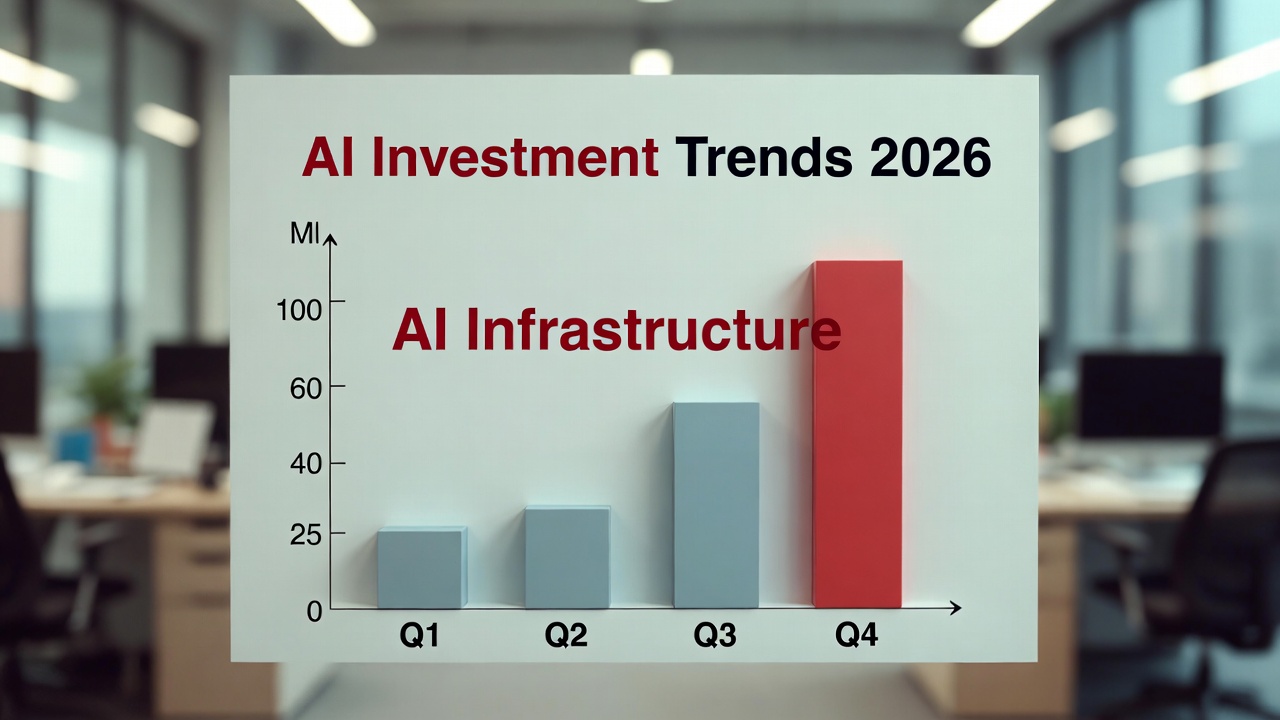
- Global AI spending may exceed $2 trillion in 2026
- Many organisations still delay up to 25% of planned AI spending due to unclear ROI
- Gartner’s market research highlights that undisciplined AI funding leads to stalled pilots and wasted budgets
- The fastest-growing AI budgets are shifting towards data governance, safety layers, and orchestration tools, not just model development
- TechyKnow analysis identifies four pillars for smarter AI investment in 2026
AI spending is accelerating at an extraordinary pace in 2026—but companies are also learning that bigger budgets don’t guarantee business transformation. Organisations that once rushed into pilots are now reassessing their priorities, looking for methods that balance innovation with discipline.
Industry research shows that global AI spending could surpass $2 trillion in 2026, up from nearly $1.5 trillion in 2025. Meanwhile, Gartner notes that AI investments often fail when companies start with technology rather than business value.
Why AI budgets keep rising while ROI stays uneven
AI is becoming a foundational capability rather than an experimental one. Yet many organisations still face familiar challenges: unclear goals, weak data foundations, fragmented workflows, and limited organisational readiness.
A Reuters survey found that businesses may delay around 25% of planned AI spending because current models do not consistently deliver value at scale.
Q: Why do AI pilots stall even when budgets are available?
Because enterprises move into implementation before validating data quality, success metrics, and business case alignment—leading to expensive rework or abandoned pilots.
TechyKnow’s 4-pillar AI investment strategy for 2026
After analysing market research, enterprise behaviour, and real-world failures, TechyKnow identifies four pillars that consistently lead to higher ROI and more stable AI deployment.
Define the problem, value, and metrics before choosing any model
This is the foundation Gartner repeatedly emphasises: poor alignment between AI capabilities and business needs triggers the majority of AI investment failures.
Strong value-first cases include:
- a real problem, not a hypothetical one
- measurable metrics
- a financial ROI timeline
- a roadmap for scaling or retiring the solution
Q: What’s the fastest way to judge an AI project’s value?
If leaders can’t explain the financial metric AI will improve—cost, revenue, speed, risk—then the investment isn’t ready.
Pick the right approach: build, buy, or blend
Enterprises often overspend by building custom systems without evaluating whether simpler, cheaper, or hybrid options exist.
TechyKnow recommends:
- Build: when proprietary competitive advantage is needed
- Buy: when speed matters more than customisation
- Blend: the most common approach—internal data + external models
This strategic choice prevents multi-year, low-ROI projects that consume huge internal budgets.
Strengthen the data foundation before scaling
Bad data is still the biggest reason AI initiatives fail.
Gartner stresses that organisations must invest in data readiness, governance, quality monitoring, and risk mitigation before funding expensive models.
High-ROI AI organisations prioritise:
- clean and structured datasets
- documented governance
- model transparency
- safety layers
- clear rules for sensitive categories
This is particularly relevant following real-world issues like the Grok AI scandal, which demonstrates the consequences of weak guardrails and inconsistent oversight.
Build organisational readiness—not just technical capability
TechyKnow’s analysis finds that the real differentiator in AI success is people, culture, and workflow readiness.
That includes:
- cross-functional education
- AI literacy
- operational redesign
- clear ownership structures
- communication and change management
Enterprises with high adoption rates treat AI as a long-term transformation, not a plug-and-play product.
A good example is customer-facing automation: many companies are scaling AI-driven support and sales experiences using virtual assistants and avatars. If you’re investing there, this guide on AI avatars in customer service is a practical reference for real deployment thinking.
2026 AI spending priorities
AI investment is no longer dominated by model development. Spending is flowing into:
- AI infrastructure & orchestration
- safety, guardrails & monitoring
- multimodal systems
- governance tooling
- enterprise data platforms
Reuters’ funding analysis shows investors have injected more than $1.6 trillion into AI startups since 2013, with over $375 billion expected again in 2026.
This indicates that AI has fully moved from experimentation to core investment.
Where AI investments go wrong
According to combined Gartner and Reuters insights, common points of failure include:
- solving the wrong problem
- unclear ownership
- skipping data preparation
- overestimating near-term value
- poor user adoption
- lack of safety layers
Q: How can leaders avoid wasting money on AI?
Adopt a phased approach: value definition → small proof-of-concept → measurable results → controlled scaling.
This replaces hype-led investment with evidence-based growth.
Recommendations for smarter AI investment in 2026
TechyKnow recommends organisations:
- validate business impact first
- calculate ROI before modelling
- invest in data foundations
- plan governance and safety from the start
- build cross-functional skills
- scale only after measurable proof
This approach keeps budgets safe while increasing the odds of long-term AI success.
Conclusion
AI investments in 2026 are shifting from excitement to discipline. Enterprises that win are no longer the ones spending the most—they’re the ones aligning AI to real business problems, strengthening their data and safety foundations, and preparing their workforce to adopt AI responsibly and confidently.
For more deep dives, research explainers, and industry trends, see artificial intelligence hub.