Key Takeaways
- AI Agents Replace Apps by turning multi-step workflows into automated outcomes across multiple systems.
- The 2026 software downturn accelerated investor push toward “agent-first platforms” that emphasize execution, not interfaces.
- Enterprise productivity increases when agents operate across CRMs, ERPs, and internal APIs without manual UI navigation.
- Successful adoption depends on strong data governance, security layers, and reliable orchestration frameworks.
- Analysts expect agents to complement — not eliminate — platforms like Salesforce or Microsoft.
AI Agents Replace Apps: The Shift That Began With the 2026 Software Crash
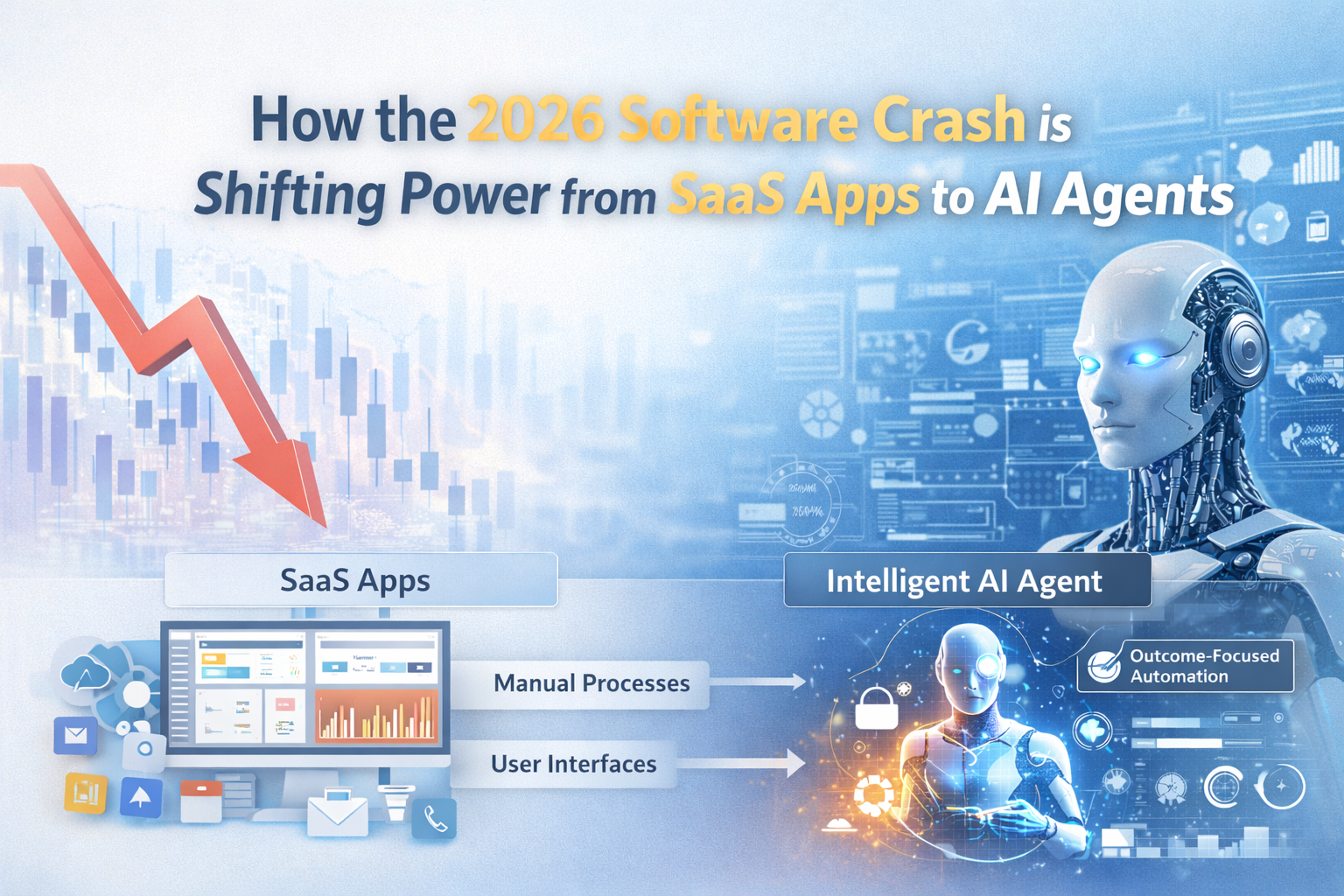
The 2026 downturn in enterprise software valuations was more than a correction — it marked the beginning of a structural shift. For the first time, the market acknowledged a new reality: AI Agents Replace Apps is not a buzzword but a foundational change in how enterprise technology delivers value.
Instead of relying purely on dashboards, forms, and menus, enterprises are now experimenting with digital agents capable of performing tasks across multiple systems. The change is so powerful that many analysts see it as the biggest evolution since the rise of SaaS itself. Business Insider reports that enterprises now expect agents to drive outcomes, not assistance.
Why AI Agents Replace Apps Is the New Enterprise Operating Model
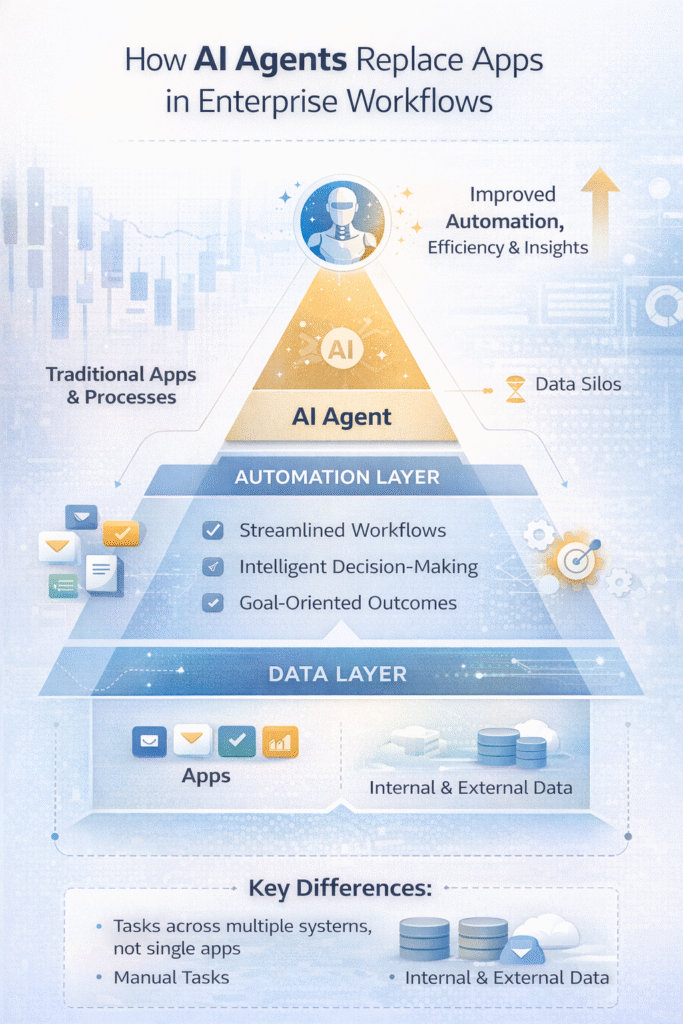
The phrase AI Agents Replace Apps reflects a deeper change in how work is performed. Instead of navigating an interface, users tell an agent what outcome they need, and the agent executes it across systems.
AI Agents Replace Apps Through Outcome-Based Execution
A typical example:
Instead of opening a CRM, searching for a client, updating records, logging tasks, and sending follow-ups, an employee can simply instruct:
“Update the renewal status and schedule a follow-up call.”
The agent handles:
- Data lookup
- Action execution
- Logging activity
- Scheduling tasks
- Cross-app communication
This model reduces the cognitive load of software navigation and reorganizes enterprise workflows around results, not steps.
User habits are also shifting beyond traditional app usage; Techyknow recently highlighted essential mobile apps people still rely on today: Mobile phone apps to Use!
Market Signals That Show Why AI Agents Replace Apps
The post-2026 software slump revealed that investors now value platforms that orchestrate work, not just store data. Several analysts note that the most resilient companies were those already developing agent layers atop their existing SaaS offerings.
External industry research reinforces this momentum:
- Gartner predicts over 40 agentic AI projects will fail by 2027 due to lack of governance, but successful ones will redefine enterprise workflows.
- EMA Research highlights enterprise AI agents as the next major frontier for workforce augmentation.
This external validation strengthens the industry shift toward agentic models.
Technical Foundations Required When AI Agents Replace Apps
Even as adoption grows, organizations face several barriers.
Data Unification Is Critical for AI Agents Replace Apps
Agents rely on:
- Real-time enterprise data
- Harmonized datasets
- Consistent context layers
- Secure permission frameworks
If data is fragmented, agents cannot make reliable decisions — and incorrect automation can introduce operational risk.
Can AI agents act independently without human oversight?
No. Enterprises must implement agent governance, audit logs, and permission boundaries. Agents can execute tasks autonomously, but oversight ensures compliance and prevents unauthorized actions.
This is especially important for companies modernizing older legacy systems.
Why AI Agents Replace Apps- But Will Not Kill Major Platforms
Analysts agree that platforms like Google Workspace, SAP, and others are not disappearing. Instead, they become the invisible infrastructure that agents operate across.
Agents enhance enterprise systems by:
- Reducing manual entry
- Making cross-department processes fluid
- Eliminating redundant navigation
- Connecting siloed platforms
As legacy creative tools begin to shift toward more automated workflows, Adobe’s recent move to place Animate into maintenance mode shows how fast traditional software models are evolving – a trend Techyknow covered.
The natural overlap: both agentic systems and cybersecurity require architectural readiness.
Organizational Strategy for the AI Agents Replace Apps Era
Forward-thinking CIOs are now preparing by focusing on:
Building Responsible Agent Governance
This includes:
- Action boundaries
- Human-in-the-loop approvals
- Agent monitoring dashboards
- Comprehensive audit trails
Ensuring Interoperability Across Systems
Agents work best when APIs are reliable, permissions are clean, and security architecture is strong.
This requires IT restructuring, similar to transformations triggered by zero-trust cybersecurity models.
Do AI agents fully replace human roles?
They replace repetitive tasks, not strategic human judgment. Agents act as “digital workers,” not decision-makers for sensitive or mission-critical choices.
Future Outlook What Happens After AI Agents Replace Apps?
The next few years will likely bring:
- Outcome-as-a-Service (OaaS): Vendors will guarantee results rather than sell app access.
- Agentic CRMs & ERPs: Systems that let agents—not humans—perform updates and actions.
- Invisible software stacks: Platforms running behind the scenes while agents handle the interface layer.
- Enterprise-wide orchestration: Agents coordinating tasks across marketing, finance, HR, and operations.
This era will not remove software, it will redefine its purpose.Platforms stay. Dashboards remain available.
But workflows become largely autonomous, optimized, and centrally governed.
Conclusion
The trend AI Agents Replace Apps marks the most significant shift in enterprise software since the birth of SaaS. Accelerated by the 2026 valuation crash, enterprises now gravitate toward agent-first automation frameworks that prioritize business outcomes rather than user interfaces.
With strong data architecture, governance, and interoperability, companies will gain dramatic efficiency. Those who delay may find their existing UI-heavy software stacks outdated much sooner than expected.