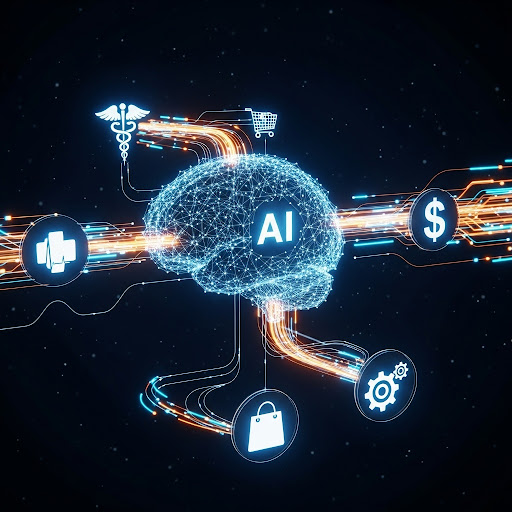
AI and Machine Learning integration is transforming how businesses operate across healthcare, finance, retail, manufacturing, and software development. This guide explains what AI–ML integration means, where it’s delivering value, the biggest risks, and what’s changing in 2026.
Key takeaways
- AI–ML integration powers predictive analytics, automation, and smarter decision-making across industries.
- Real impact is strongest in diagnostics, fraud detection, personalization, and predictive maintenance.
- The biggest risks are data bias, privacy compliance, and energy-heavy model training.
- 2026 trend is more “responsible scaling” — better governance, greener training, and privacy-preserving methods becoming standard.
What Is AI and Machine Learning Integration?
AI and Machine Learning integration refers to the seamless combination of AI systems—designed to mimic human intelligence—and ML algorithms, which enable machines to learn from data and improve over time. In 2025, advancements in computational power, big data, and sophisticated algorithms like deep learning have made this integration more robust and accessible. Together, they power everything from predictive analytics to autonomous systems, revolutionizing industries worldwide.
Is AI and ML integration the same as “using AI”?
Not exactly. AI–ML integration usually means systems that learn from data continuously (ML) and use that learning to power intelligent decisions or automation (AI), rather than static rule-based tools.
Key Applications of AI and ML Integration in 2025
The real-world applications of AI and Machine Learning integration are vast and growing. Here’s how they’re making waves across key sectors:
Healthcare: Precision and Efficiency
In healthcare, AI and ML are enhancing diagnostics and patient care. AI-driven tools analyze medical images to detect diseases like cancer with greater accuracy than ever before. For example, recent systems in 2025 can identify early-stage tumors in under 10 seconds, outpacing traditional methods. ML also powers predictive models that personalize treatment plans, improving patient outcomes while reducing costs.
Does AI replace doctors in diagnosis?
No — in most real workflows, AI supports clinicians by speeding up detection and surfacing patterns, while final decisions still require professional judgment.
Finance: Security and Speed
The financial industry relies heavily on AI and ML integration for fraud detection, risk assessment, and customer service. Banks like JPMorgan Chase use AI to monitor transactions in real-time, flagging suspicious activities with 98% accuracy. Meanwhile, ML-driven chatbots handle millions of customer inquiries daily, cutting response times from minutes to seconds.
Retail: Personalization at Scale
Retailers are leveraging AI and Machine Learning integration to boost sales through personalized recommendations and optimized inventory management. Amazon’s recommendation engine, powered by ML, drives 35% of its revenue by predicting what customers want before they know it themselves. In 2025, AI also helps retailers forecast demand with pinpoint accuracy, minimizing waste and maximizing profits.
Manufacturing: Smarter Operations
In manufacturing, AI and ML optimize production lines and predict equipment failures. Companies like Siemens use predictive maintenance—enabled by ML—to reduce downtime by up to 30%. This integration ensures factories run smoother, smarter, and more sustainably in 2025.
How AI and ML Integration Enhances Software Development
Beyond industries, AI and Machine Learning integration is revolutionizing software development. Low-code and no-code platforms now embed AI features, automating tasks like code generation and testing. A 2025 survey shows that 72% of developers using these platforms build apps twice as fast as with traditional coding, democratizing software creation for non-experts.
Is AI making software development fully automated?
Not fully. AI speeds up repetitive tasks (generation, testing, debugging support), but architecture, security, and complex integration still require strong engineering decisions.
Explore next-gen chip-level acceleration in neuromorphic computing software for edge ai.
Challenges of AI and Machine Learning Integration
While the benefits are undeniable, AI and ML integration comes with challenges that must be addressed:
- Data Bias: AI systems can inherit biases from flawed datasets, leading to unfair outcomes. For instance, facial recognition tools in 2025 still struggle with accuracy across diverse demographics, highlighting the need for inclusive data.
- Privacy Issues: Processing vast amounts of personal data raises concerns. With regulations like GDPR evolving, businesses must navigate complex compliance landscapes.
- Environmental Cost: Training large ML models consumes significant energy. A single model’s carbon footprint can rival that of five cars over their lifetimes, pushing companies to adopt greener practices.
What is the biggest risk for companies adopting AI–ML fast?
Usually governance: biased data, unclear accountability, and weak privacy controls can scale problems faster than benefits.
If you’re implementing AI with personal data, use this as your baseline reference for GDPR.
The Future of AI and ML Integration
Looking ahead, AI and Machine Learning integration will only grow stronger. Gartner predicts that by 2027, 70% of enterprises will use AI to enhance operations, up from 40% in 2024. Emerging trends like federated learning—training models on decentralized data while preserving privacy—are gaining momentum. By 2030, AI could automate 50% of repetitive tasks, shifting human focus to creative and strategic work.
However, challenges like job displacement loom large. The World Economic Forum estimates AI could displace 85 million jobs by 2025 but create 97 million new ones, underscoring the need for reskilling programs.
In 2026, the shift is less about “adding AI” and more about scaling it responsibly — stronger model monitoring, clearer audit trails for decisions, privacy-preserving learning, and efficiency-focused training so AI adoption doesn’t come with unnecessary risk or cost.
Want the full context behind the 85 million and 97 million jobs estimate? Read the World Economic Forum Future of Jobs Report.
Conclusion
AI and Machine Learning integration is a game-changer, offering unparalleled efficiency and innovation. Yet, its success hinges on addressing ethical, environmental, and social challenges. By striking this balance, businesses and society can unlock AI’s full potential for a brighter, smarter future.
See how workflow automation is transforming development in low code no code trends.