
KEY TAKEAWAYS
- Claude AI Vulnerability Scanner debuted with claims of rapid security flaw detection.
- Its announcement triggered a market dip in cybersecurity stocks.
- Analysts warn about over-reliance on AI security tools and regulatory uncertainty.
- Security firms fear disruption of traditional penetration-testing models.
- Experts suggest balancing AI automation with human-led oversight.
The Claude AI Vulnerability Scanner has rapidly become a headline driver in the global cybersecurity community, after its introduction by the AI company behind Claude reportedly caused cybersecurity stocks to plunge overnight. According to the original report by SecurityWeek, the tool’s advanced automated scanning capabilities raised concerns among investors about the future relevance of traditional cybersecurity firms.
Claude AI Vulnerability Scanner and Its Industry Impact
The Claude AI Vulnerability Scanner is designed to autonomously detect, classify, and assess software vulnerabilities at unprecedented speed an innovation some experts consider revolutionary, while others view it as potentially destabilizing. With AI rapidly reshaping digital defense, this new tool stands as another example of how automation can shift the balance of power in cybersecurity markets.
Industry reactions were swift. Shares of major security companies dipped as investors speculated whether AI-driven platforms could replace or significantly reduce demand for manual penetration testing services.A similar AI disruption trend was seen earlier in discussions about AI-powered cyber risks, which you can read more about in Techyknow’s analysis here: AI Cybersecurity Reckoning Claude AI
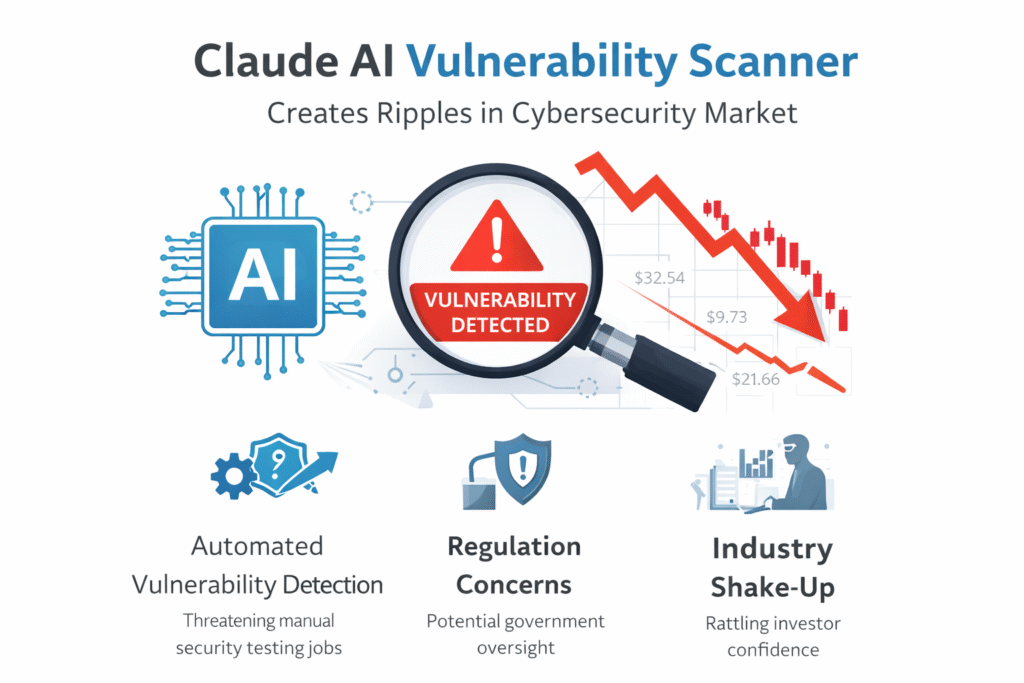
Why the Claude AI Vulnerability Scanner Triggered Market Volatility
Financial analysts note that the Claude tool’s release posed three immediate concerns:
- Automation Threat
Traditional vulnerability scanners require teams of analysts and manual verification. Claude’s approach promises to bypass this labor-intensive layer entirely. - Speed & Cost Efficiency
AI-driven scans could be far cheaper compared to enterprise contracts worth millions annually. - Unknown Regulatory Pathways
AI cybersecurity tools may face upcoming regulation by bodies like the EU Agency for Cybersecurity (ENISA). Uncertainty around compliance added pressure to the market.
During the coverage, one recurring question among IT teams has been:
“Is the Claude AI Vulnerability Scanner accurate enough to replace traditional penetration testing?”
Current expert consensus suggests it can dramatically speed up scanning but cannot yet replace human-led investigation, especially in mission-critical or highly sensitive environments.
Claude AI Vulnerability Scanner Raises Questions About Over-Reliance on AI
Despite the hype surrounding the launch, cybersecurity leaders are urging a balanced perspective. AI scanners can help organizations identify known vulnerabilities but may struggle with zero-day threats, complex attack chains, or deception-based intrusions.
Interestingly, similar risks were highlighted when discussing evolving malware threats like those in Techyknow’s coverage of Resurge Malware Ivanti Cybersecurity threat.
This context underscores why some CISOs caution against assuming AI-driven scanners are a silver bullet.
Real-World Use Cases of the Claude AI Vulnerability Scanner
Initial testing according to public statements from Anthropic,suggests the scanner could assist in:
- Identifying misconfigurations in cloud infrastructure
- Detecting outdated libraries in CI/CD pipelines
- Automating compliance audits for GDPR, ISO 27001, and SOC 2
- Prioritizing vulnerabilities based on risk levels using machine learning
However, experts point out that AI can also generate false positives, leading to workflow inefficiencies if human review isn’t properly integrated.
How does the Claude AI Vulnerability Scanner differ from existing scanning tools?
Unlike traditional scanners that rely on predefined signatures or manual configurations, the Claude tool leverages generative AI reasoning to analyze code patterns, potential exploit paths, and configuration weaknesses. This makes it faster in theory, but accuracy still depends on proper training data and oversight.
Claude AI Vulnerability Scanner and the Future of Cybersecurity Jobs
One reason cybersecurity stocks fell is due to fears about job displacement. Automated scanning platforms may reduce the need for junior analysts who traditionally handle routine vulnerability assessments.
Yet, cybersecurity hiring experts suggest the opposite: automation could actually increase demand for AI-literate professionals skilled in validation, adversarial analysis, and AI tool supervision.Many organizations are already preparing hybrid roles where human analysts interpret and verify AI-generated vulnerability reports.
Attackers gain speed in Cybersecurity Race Analysis!
Market Analysts Predict Short-Term Shock, Long-Term Growth
While markets reacted sharply, analysts expect recovery as companies adopt AI-enhanced workflows instead of replacing entire departments.
Some firms even plan to integrate the Claude AI Vulnerability Scanner into multi-layered security strategies combining:
- Human penetration testers
- AI anomaly detection systems
- Threat intelligence feeds
- Automated patching pipelines
This layered approach ensures that automation strengthens not weakens organizational security posture.
Is the Claude AI Vulnerability Scanner secure for enterprise adoption?
Security experts note that although the tool offers impressive capabilities, enterprises must evaluate data privacy policies, cloud handling, and vendor security standards before integration. AI tools themselves can become attack vectors if not properly safeguarded.
Claude AI Vulnerability Scanner – What Comes Next for the Industry?
As organizations look beyond the immediate stock market turbulence, many consider the scanner a milestone in AI-powered cybersecurity evolution. It highlights the beginning of a shift toward autonomous vulnerability analysis, but also exposes regulatory and ethical challenges ahead.
What’s clear is that cybersecurity firms must innovate rapidly to remain competitive while reassuring investors and customers alike.
Final Thoughts
The Claude AI Vulnerability Scanner has sparked a moment of reflection for the cybersecurity world. While markets reacted abruptly, the long-term implication points toward a future where AI and human expertise work together not against each other to defend digital infrastructure.