Key Takeaways
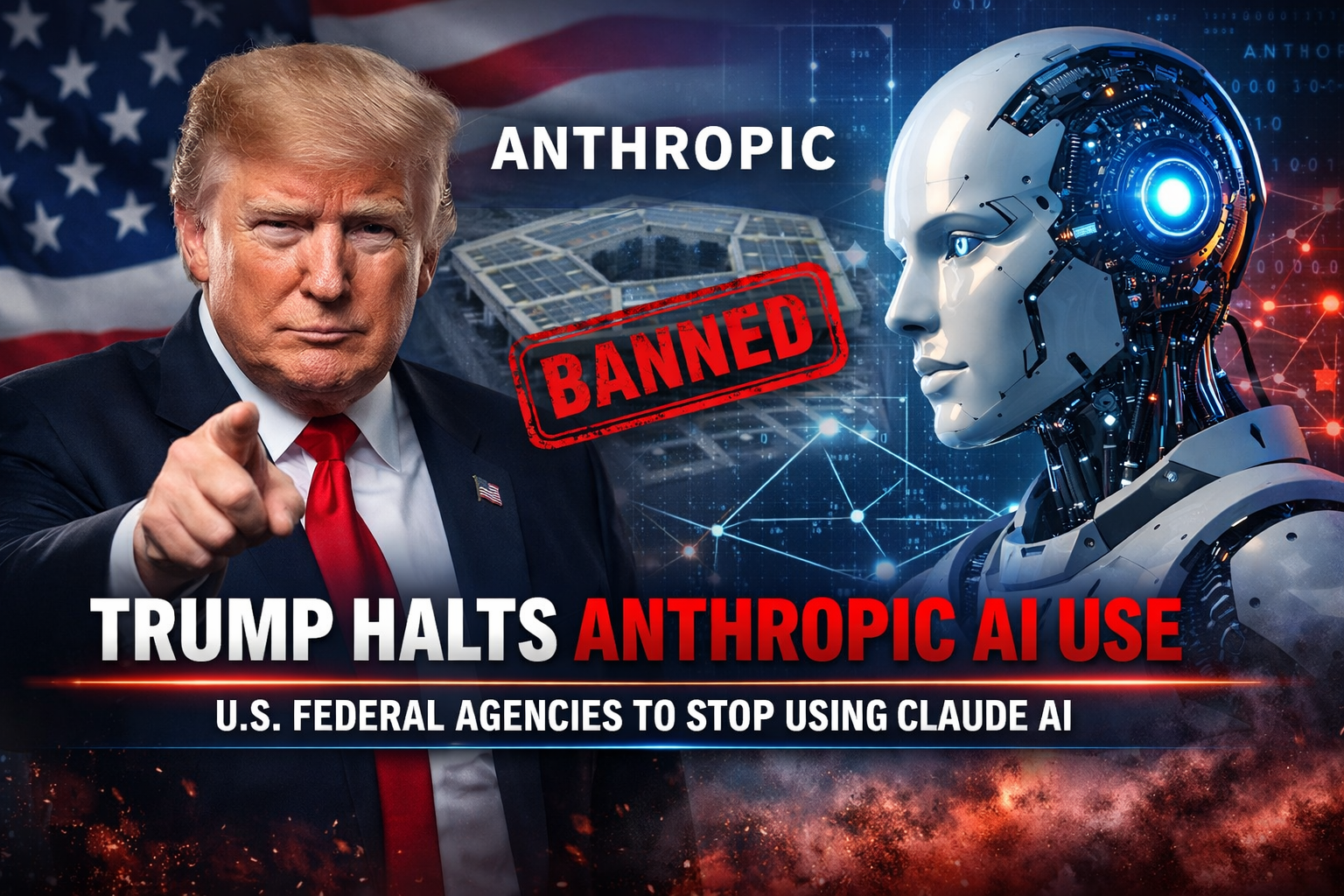
- President Donald Trump orders all federal agencies to cease using Anthropic technology within six months.
- The Pentagon labels Anthropic a “supply-chain risk”—a rare designation for a U.S. company.
- Anthropic plans a legal challenge to overturn the Pentagon’s decision.
- OpenAI maintains a separate agreement with the Defense Department.
- The decision may reshape global AI governance, ethics debates, and military AI adoption.
Trump Halts Anthropic AI Use — Understanding the Federal Directive
The story begins with a direct order: Trump halts Anthropic AI use across all federal agencies, following months of tension between the AI company and U.S. defense officials over acceptable use rules. According to reporting from Reuters, Trump issued the directive after the Pentagon formally categorized Anthropic as a supply-chain risk a designation typically used against firms tied to adversarial nations, not domestic innovators.
According to an exclusive report confirmed by Reuters, the directive instructs all federal agencies to phase out Anthropic technology within six months.
This move means government departments using Anthropic’s Claude models for cyber-defense research, intelligence analysis, and secure communications must begin an immediate phase-out.
The reasoning traces back to Anthropic’s strict safety constraints: Claude refuses to support autonomous weapon development, mass domestic surveillance, or high-risk intelligence manipulation principles embedded in the model’s training. These guardrails clashed with the Defense Department’s desire for greater operational freedom, ultimately leading to the government’s move.Within the administration, officials insisted that reliance on technology governed by private-sector ethics can compromise national interest. Trump echoed this concern in public remarks, stating that national defense cannot be dictated “by the moral preferences of AI developers.”
Why Trump Halts Anthropic AI Use and What Triggered the Pentagon’s Decision
When the Pentagon announced its supply-chain risk ruling, it cited concerns about long-term reliability, continuity of access, and resistance to federal security directives. Anthropic’s refusal to loosen its safety constraints for military autonomy tools became the tipping point. Reuters notes that disagreements over defense-related restrictions inside Claude AI models were central to the Pentagon’s decision to classify Anthropic as a supply-chain risk.
At the same time, OpenAI moved forward with a carefully negotiated framework that allows its AI systems to be used in national-security environments with conditions tied to human-in-the-loop oversight. This contrast widened the strategic divide between the two AI companies.
As federal officials began evaluating critical vendors, Anthropic’s resistance to unrestricted deployment triggered formal action. Trump’s subsequent directive to halt Anthropic AI use is essentially a nationwide operational extension of that Pentagon assessment.
Why did the Pentagon consider Anthropic a risk?
Because the company’s strict usage policies including bans on autonomous weapons and mass surveillance restricted the military’s ability to use Claude for strategic, sensitive, or classified missions. That limitation, officials argued, created uncertainty around national-security capabilities.
Impact on Federal Agencies and High-Security Operations
The phase-out will affect departments that integrated Anthropic’s models for data-analysis workflows, predictive modeling, cybersecurity research, and secure inter-agency communications. This includes segments of the intelligence community that opted for Claude’s safety-focused reasoning strengths.
Agencies now face a six-month window to migrate sensitive systems away from Anthropic tools. Alternatives include OpenAI’s latest models, as well as domestic cloud-integrated AI platforms operated by Amazon and Microsoft.
A relevant parallel can be seen in the ongoing antitrust probe in Japan involving Microsoft’s Azure ecosystem, which raised concerns around cloud dominance and vendor dependenc a dynamic also relevant to federal AI procurement.
Read: Microsoft Japan Probe Azure Antitrust
Will everyday users of Claude be affected?
No. The directive applies only to U.S. federal agencies. Commercial, academic, and consumer access to Claude remains unchanged for now.
Industry Reactions and the Broader AI Landscape
Tech analysts note that the timing of this decision corresponds with heightened geopolitical AI competition. Governments worldwide are assessing how much control private AI firms should maintain over model behavior, and whether national-security exemptions should override ethical boundaries set by developers.
Many investors are evaluating how this affects Anthropic’s growth trajectory, particularly as the company is reportedly exploring significant future funding rounds and potential public-market pathways. For readers tracking AI-driven market shifts, our extended guide on best tech stocks to buy offers timely context on how AI regulation impacts market confidence:
The U.S. government, meanwhile, appears to be signaling that AI suppliers working with national-security institutions must be fully aligned with federal strategic objectives, not just corporate ethics.
Anthropic’s Legal Challenge and What Comes Next
Anthropic has announced plans to challenge the Pentagon’s designation in court. Company representatives argue that labeling a U.S. AI firm as a supply-chain risk for following ethical safety guidelines sets a dangerous regulatory precedent. They maintain that the model’s safety restrictions are essential to preventing misuse.
The legal appeal will determine whether private AI companies retain the right to limit or veto certain government use cases an issue that could reverberate across global AI governance.
Industry experts believe the review could take months, creating uncertainty for both government agencies and private defense contractors who relied on Claude’s analytical capabilities.
Can Anthropic reverse the ban if it wins in court?
Potentially. A successful legal challenge could overturn the Pentagon’s designation, allowing federal agencies to resume select deployments of Claude—though new federal guidelines may still impose constraints.
Geopolitical and Ethical Implications of Trump’s Decision
By making the order public and forceful, the administration is aiming to send a message: national-security AI deployment must be unrestricted, resilient, and aligned with federal strategic priorities.
This raises long-standing debates:
- Should private AI makers have veto power over government use?
- Should ethics policies override defense demands?
- Are federal AI systems safer or riskier without private-sector constraints?
As AI becomes central to national defense strategy, the answers to these questions will shape long-term policy.
Conclusion
The decision to halt Anthropic AI use across federal agencies is more than an administrative shift; it marks a decisive moment in the battle between AI ethics and national-security imperatives. The outcome of Anthropic’s legal challenge and the government’s procurement realignments could define the next era of AI governance in the United States.