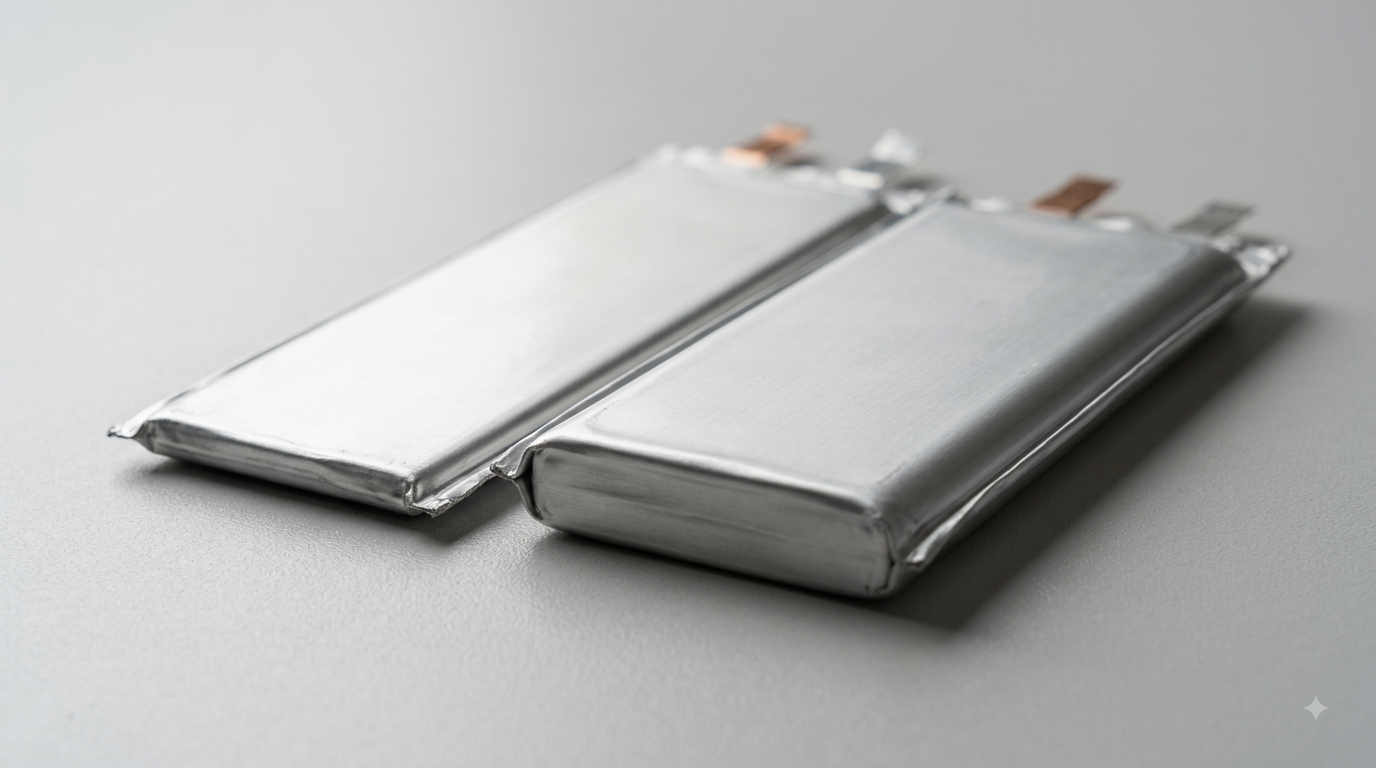
Something changed in smartphones over the past two years that nobody explained particularly well.
Phones started lasting noticeably longer between charges without getting thicker or heavier. For most of the previous decade, more battery meant more bulk — a straightforward trade every manufacturer had to make. Then the trade got easier, quietly, and the spec sheets started listing capacities that would previously have required a chunkier phone.
The reason is a change in what the battery is made of. Specifically, in the anode.
Silicon-carbon batteries began appearing in phones from Honor, Oppo and Xiaomi, and the technology has since spread — Samsung now uses it in the Galaxy Z Fold 8 line, and it has moved into accessories, where it is why some 2026 power banks are startlingly thin.
Here is what actually changed, what the marketing overstates, and the question about long-term battery health that almost no coverage will answer for you.
Table of contents
- What a silicon carbon battery actually is
- Why silicon, and why it took so long
- What you actually get
- The degradation question
- Are they safe?
- Which devices use them
- Silicon carbon in power banks
- Should this change what you buy?
- FAQs
What a silicon carbon battery actually is
A silicon-carbon battery is a lithium-ion battery with a silicon-based anode instead of a mostly graphite one.
That is the whole change. It is not a new battery chemistry, not a replacement for lithium-ion, and not related to solid-state batteries — the other technology frequently discussed in the same breath. It is an upgrade to one component inside a familiar design.
Some quick orientation, because the anode is where the interesting part happens. A lithium-ion battery has two electrodes. When charging, lithium ions move into the anode and are stored there; when discharging, they move back out. How much the anode can hold determines how much energy the battery stores.
Traditional anodes are made largely of graphite. Silicon can hold considerably more lithium in the same physical volume. Swap the material and you get more capacity from the same space — which is why manufacturers describe silicon-carbon as a density improvement rather than a new battery type.
Why silicon, and why it took so long
If silicon holds more, an obvious question follows: why was everyone using graphite?
Because silicon has an awkward physical property. It swells substantially as it absorbs lithium, then shrinks again as it releases it. In an anode that expands and contracts on every charge cycle, the material cracks, breaks apart, loses electrical contact and stops working. Early silicon anodes degraded quickly enough to be commercially useless.
The engineering answer is what the “carbon” in the name refers to. Tiny silicon particles are wrapped inside a protective carbon structure — often described as a honeycomb or scaffold — which stabilises the silicon and manages the expansion while holding the structure together. The comparison manufacturers reach for is steel reinforcing concrete: the concrete does the work, the steel stops it failing under stress.
It is worth sitting with that for a moment, because it tells you where the risk lives. The entire viability of this technology rests on how well the expansion is managed over hundreds of cycles. That is an engineering quality question, which means implementations differ, and a cheap silicon-carbon battery is not automatically equivalent to a well-made one.
What you actually get
Three practical benefits, and it is worth being careful about which figures are independently established.
More capacity in the same space. This is the headline. Manufacturer and industry figures commonly cited put the improvement in the range of 40–55% more energy in the same volume. Treat those as manufacturer-derived rather than independently verified — the direction is not in dispute, but the specific percentage varies by implementation and by who is doing the measuring. What you observe as a buyer is simpler: phones with capacities that would previously have required a thicker chassis.
Design freedom rather than just endurance. The gain gets spent in one of two ways. Some manufacturers keep the phone the same size and give you more battery. Others keep the capacity and make the device thinner or lighter. Both are legitimate uses of the same improvement, and it explains why two phones with the technology can feel like very different products.
Faster charging, with a caveat. Silicon-carbon cells generally support higher charging rates, and reporting suggests they can run cooler under heavy use — which matters because heat is the main enemy of battery longevity. The caveat is that charging speed depends on the charging system as much as the cell, so this is an enabler rather than a guarantee.
The degradation question
This is the section the competing articles skip, and it is the one that should determine whether you care.
The concern is straightforward. Silicon anodes work by managing expansion that would otherwise destroy them. Managing a stress is not the same as eliminating it. A reasonable person asks whether a silicon-carbon battery still holds a good charge after two or three years, or whether the early capacity advantage erodes faster than a conventional cell’s.
The honest answer is that the long-term field data is still thin. The technology reached mainstream phones recently enough that large-scale, multi-year, independent measurements of real-world degradation across many implementations do not yet exist in the way they do for conventional lithium-ion. Anyone giving you a confident number for how a silicon-carbon phone will perform in 2029 is extrapolating.
What can be said fairly:
- Degradation was the original blocking problem, and the carbon scaffold exists specifically to address it. Manufacturers shipping in volume have clearly satisfied themselves it is manageable.
- Implementation quality matters more here than in conventional cells, because the failure mode is mechanical. Thermal management and cell design are doing real work.
- Running cooler, if it holds in practice, works in favour of longevity rather than against it.
TechyKnow’s assessment: we would not avoid a phone because it uses a silicon-carbon battery, and we would not treat manufacturer longevity claims as established. If you keep phones for four or five years, this is the specification to watch independent testing on over the next two years. If you upgrade every two or three, it is very likely a straightforward gain.
Are they safe?
Yes, in the same sense and to the same degree as any lithium-ion battery.
Silicon-carbon cells are lithium-ion cells with a different anode material. They are subject to the same safety engineering, the same protection circuitry, the same transport regulations and the same certification regimes. There is no known category-level safety concern specific to the chemistry.
The general lithium-ion rules still apply, and they apply here for the same reasons: buy from reputable manufacturers, avoid unbranded cells and chargers, do not use physically damaged batteries, and treat swelling or unusual heat as a reason to stop using the device rather than a quirk.
Which devices use them
Adoption was led by Chinese manufacturers. Honor, Oppo and Xiaomi drove early deployment, and the technology has since become common enough across their ranges to stop being a differentiator.
The notable recent development is broader adoption — Samsung has moved to silicon-carbon in the Galaxy Z Fold 8 and Z Fold 8 Ultra. Foldables are a logical early target, since internal volume is the binding constraint on that form factor and any density gain is worth more there than in a conventional slab phone.
Specific model availability changes constantly and varies by region, so check the current specification for any device you are considering rather than relying on a list. It is also worth noting that manufacturers do not always advertise the anode material prominently — a suspiciously high capacity in a thin phone is often the tell.
Silicon carbon in power banks
The application getting less attention, and arguably the one where the difference is most visible.
Power banks are a pure volume-versus-capacity product. Nobody wants to carry one, and the only reason to tolerate it is the charge it holds. A density improvement therefore translates directly into a better product, and it is why 2026 has produced power banks at thicknesses that would have been impossible with graphite anodes at the same capacity.
The buying guidance mirrors the phone guidance and matters more, because the market is less regulated. This is a category with a large volume of cheap unbranded product, and the failure mode for a poorly built silicon-carbon cell is mechanical. Thermal management and build quality are worth paying for. A remarkably thin, remarkably cheap, remarkably high-capacity power bank from a brand you have never heard of is a claim, not a specification.
Should this change what you buy?
Four honest positions.
If you are buying a phone this year: it is a genuine plus and should not be the deciding factor. Silicon-carbon is becoming standard rather than exceptional, and by your next upgrade it will likely be unremarkable. Buy the phone, not the anode.
If battery life is your main priority: it is worth actively seeking out, particularly in thinner devices where the density gain does the most work.
If you keep devices for four or five years: this is where the honest uncertainty matters. Watch for independent longevity testing before treating it as a clear win, and weight manufacturer reputation more heavily than the specification.
If you are buying a power bank: the benefit is real and immediate, and brand quality matters more than in almost any other accessory category.
The wider point is one worth carrying into any gadget purchase: the interesting changes in consumer hardware are increasingly happening at the materials level rather than the feature level, and materials changes are much harder to evaluate from a spec sheet than a new camera or a faster chip. A capacity figure tells you what the battery holds today. It tells you nothing about what it holds in three years, and the second number is the one you actually live with.
The practical next step: if you are comparing two phones, check capacity against physical thickness. A high mAh figure in a slim body is the clearest signal that silicon-carbon is doing the work, whether or not the marketing mentions it.
FAQs
What is a silicon carbon battery?
A silicon carbon battery is a lithium-ion battery that uses a silicon-based anode instead of a mostly graphite one. Silicon holds more lithium in the same volume, so the battery stores more energy in the same physical space. It is an upgrade to one component rather than a new chemistry, and it is unrelated to solid-state batteries.
How is a silicon carbon battery different from lithium-ion?
It is a type of lithium-ion battery. The difference is the anode material. Traditional lithium-ion uses mostly graphite; silicon carbon uses silicon particles held in a protective carbon structure, which allows greater energy density in the same space.
Do silicon carbon batteries degrade faster?
Long-term independent field data is still limited, because the technology reached mainstream phones recently. Degradation was the original obstacle — silicon swells as it charges — and the carbon scaffold exists specifically to manage that. Implementation quality matters more than in conventional cells, so manufacturer reputation is a reasonable proxy.
Do silicon carbon batteries charge faster?
They generally support higher charging rates and are reported to run cooler under heavy load, which is favourable for longevity. Actual charging speed depends on the device’s charging system as well as the cell, so the technology enables fast charging rather than guaranteeing it.
Which phones have silicon carbon batteries?
Adoption was led by Honor, Oppo and Xiaomi, and it has since become common across their ranges. Samsung uses the technology in the Galaxy Z Fold 8 and Z Fold 8 Ultra. Availability changes frequently and varies by region, so check the current specification for any specific model.
Are silicon carbon batteries safe?
They are lithium-ion batteries with a different anode material and are subject to the same safety engineering, protection circuitry and certification. There is no known category-level safety concern specific to the chemistry. Standard lithium-ion precautions apply — buy reputable brands and stop using any battery that swells or overheats.
How much more capacity do silicon carbon batteries actually offer?
Commonly cited figures put the improvement at roughly 40–55% more energy in the same volume, though these are largely manufacturer-derived and vary by implementation. The observable effect is more useful than the percentage: capacities that previously required a thicker device now fit in a slim one.
Are silicon carbon power banks worth buying?
The density gain translates directly into a thinner or higher-capacity power bank, so the benefit is real. Build quality matters more than usual, because the failure mode is mechanical — a very cheap, very thin, very high-capacity power bank from an unknown brand should be treated sceptically.