
SaaS pricing has been stable for fifteen years. You paid per user per month, you counted your users, and your budget was predictable. That model is coming apart, and the reason is straightforward: when software can do work that previously required a person logged in, charging by the person stops making sense.
Vendors have moved fast. Reporting covering the period from April to August 2026 described more change in software pricing than the previous five years combined, with named enterprise vendors rebuilding how they bill.
Almost all the commentary on this has been written for software companies deciding how to reprice. This article is written for the person on the other side of the quote.
Contents
- What is changing in SaaS pricing?
- The six shifts
- Why vendors moved
- What this means for your budget
- Questions to ask before signing
- What you can still negotiate
- FAQs
What is changing in SaaS pricing?
SaaS pricing is moving from seats to consumption and outcomes. Instead of paying a fixed amount per user, you increasingly pay for what the software does — tasks completed, conversations resolved, credits consumed, or actions taken.
The practical difference is predictability. Per-seat billing gave you a number you could forecast twelve months out. Consumption billing gives you a number that depends on usage you may not control or fully understand.
That is the central buyer problem this creates, and it is worth naming plainly before looking at the specifics.
The six shifts
1. Enterprise vendors are moving off seats entirely. ServiceNow reported that half its net-new business is no longer sold by seat. That is not an experiment at the edges — it is the majority of new revenue at a major enterprise vendor.
2. Outcomes are being priced directly. Salesforce put a price on a single agent resolution. Instead of paying for a licence and using it however you like, you pay when a specific outcome occurs.
3. Some vendors are cutting their own revenue to do it. HubSpot moved to charging only for conversations its AI resolved, and took a guidance hit as a result. That detail matters — it suggests the shift is being driven by competitive necessity rather than by revenue opportunity.
4. Credits are replacing licences. GitHub, Notion, monday.com, Gong and Docusign have all rebuilt billing around credit systems. Credits are flexible for vendors and opaque for buyers, which is the tension.
5. Pricing pages have become harder to compare. When one vendor charges per seat, one per resolution and one per credit, like-for-like comparison stops being possible without modelling your own usage.
6. The cost curve moved from linear to variable. Adding a person used to add a known amount. Now adding volume adds an amount you have to estimate.
TechyKnow analysis: We think the third point is the most revealing and the least discussed. A vendor voluntarily reducing what it charges, and absorbing the financial consequence, is not behaving like a company that discovered a pricing opportunity. It is behaving like a company that concluded the old model would not survive contact with AI-capable competitors. That reading suggests this shift is structural rather than a passing repricing cycle — which matters, because structural changes do not reverse when the hype cools.
Why vendors moved
The logic is worth understanding because it tells you what to expect next.
Per-seat pricing worked because seats correlated with value. More employees using the software meant more value delivered, so more revenue was fair on both sides.
AI broke that correlation. If a support team of ten becomes a team of three plus an AI system handling routine tickets, the customer gets the same or more value from a third of the seats. Under per-seat billing, the vendor’s revenue falls while the value it delivers rises.
No vendor can accept that outcome. So they repriced around what the software actually does rather than how many people touch it.
That is a genuinely defensible reason, and buyers who understand it will negotiate better than buyers who treat it as opportunism.
It also explains why more teams are asking whether to build it yourself instead — repricing changes the maths on that decision.
What this means for your budget
Three practical consequences.
Forecasting gets harder. A consumption-based contract cannot be budgeted from headcount. You need a usage estimate, and your first-year estimate will probably be wrong.
Costs can rise without a decision being made. Under per-seat pricing, spending increased when someone approved a new licence. Under consumption pricing, spending increases when usage increases — which can happen because a team got busier, not because anyone chose to spend more.
Savings from efficiency may not reach you. If you deploy AI to reduce manual work, and your vendor charges by outcomes achieved, some of that efficiency gain is captured in your bill rather than your budget. This is the single most important thing to model before signing.
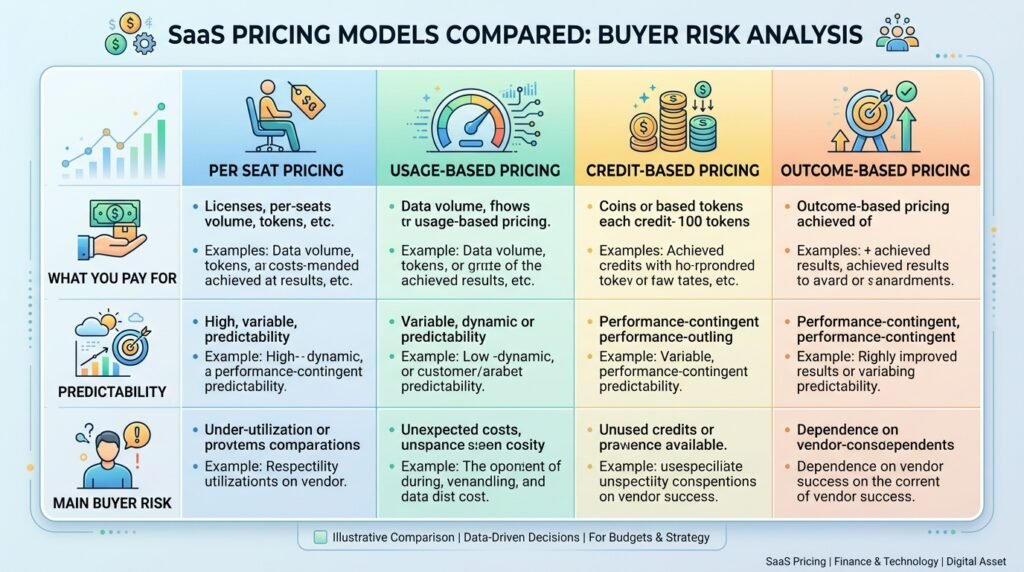
| Model | You pay for | Predictability | Main buyer risk |
|---|---|---|---|
| Per seat | Named users | High | Paying for unused licences |
| Usage / consumption | Volume processed | Low | Unbudgeted spikes |
| Credits | Prepaid units | Medium | Opaque conversion rates; expiry |
| Outcome-based | Results delivered | Low to medium | Efficiency gains captured by vendor |
Questions to ask before signing
Take these into the renewal conversation.
- What exactly counts as a billable event? Get the definition in writing. “Resolution,” “task” and “action” mean different things to different vendors, and the definition is where the money is.
- What happens if we exceed our estimate? Overage rates, and whether they are capped.
- Do unused credits expire or roll over? Expiry is common and rarely prominent.
- Can we see twelve months of our own usage data? If the vendor cannot show you what you would have been billed under the new model, you cannot evaluate the quote.
- What is the cost if usage doubles? Model the bad case, not the expected case.
- Is there a floor or minimum commitment? Consumption pricing with a high minimum is per-seat pricing wearing a different name.
- How does pricing change if we reduce usage through our own automation? The answer tells you who captures your efficiency gains.
What you can still negotiate
More than most buyers assume, because vendors are still calibrating these models.
- Price caps and collars. A ceiling on year-over-year increase is often available and rarely offered unprompted.
- A transition period. Ask to be billed under the old model for a year while you gather usage data. Vendors moving customers off seats frequently accept this.
- Definitional precision. Negotiating what counts as a billable event is usually more valuable than negotiating the rate.
- Usage reporting. Insist on visibility you can monitor monthly, not an annual reconciliation.
- Rollover. Credit expiry is a negotiable term far more often than it appears.
The general principle: in a repricing transition, vendors care more about moving you onto the new model than about maximising the first year’s revenue. That is leverage, and it expires once the model settles.
The bottom line
SaaS pricing is moving off seats permanently, and the reason is sound rather than cynical. AI broke the link between headcount and value, and vendors repriced around what their software delivers instead.
For buyers, the risk is not that software becomes more expensive. It is that it becomes less predictable, and that efficiency gains you paid to achieve end up in someone else’s revenue line.
The defence is unglamorous: understand what counts as a billable event, model the bad case, and negotiate the definition rather than the rate. Do that before the transition period closes.
FAQs
What is happening to SaaS pricing in 2026? It is shifting from per-seat billing toward consumption, credit and outcome-based models. Reporting covering April to August 2026 described more change than the previous five years, with ServiceNow, Salesforce, HubSpot, GitHub, Notion, monday.com, Gong and Docusign all named as having changed how they bill.
Why are vendors moving away from per-seat pricing? AI broke the link between the number of users and the value delivered. If AI lets a team do the same work with fewer logins, per-seat revenue falls while delivered value rises — an outcome no vendor can sustain.
What is outcome-based pricing? You pay when a specific result occurs rather than for access. Salesforce pricing a single agent resolution is an example: the charge attaches to the resolution, not to a licence.
What is credit-based SaaS pricing? You buy prepaid units consumed by different actions at different rates. It is flexible for vendors and harder for buyers to forecast, since conversion rates and expiry terms vary.
Will SaaS become more expensive? Not necessarily. The clearer change is that it becomes less predictable. The specific risk is that efficiency gains from your own automation get captured in a usage-based bill rather than reducing your costs.
How do I budget for usage-based software? Ask the vendor for twelve months of your own usage data priced under the new model, then model a scenario where usage doubles. Negotiate a cap on year-over-year increases.
Can I stay on per-seat pricing? Sometimes, at least temporarily. Vendors transitioning customers often accept a further year on the existing model. Ask — it is rarely offered unprompted.
What is the most important term to negotiate? The definition of a billable event. What counts as a “resolution,” “task” or “action” determines your bill more than the headline rate does.