
Patch management used to have a comfortable rhythm. Vendors disclosed vulnerabilities, security teams assessed them over a week or two, changes went through a maintenance window, and the risk window was usually acceptable.
August 2026 made that rhythm look reckless. A maximum-severity flaw in SAP Commerce Cloud drew exploitation attempts within days of its patch. A newly patched VMware vCenter vulnerability was weaponised by a suspected state-linked group to deploy ransomware. Microsoft shipped patches for 421 CVEs in a single month, one of them already being exploited as a zero-day.
None of that is unusual any more, which is exactly the problem. The interval between “a fix exists” and “attackers are using it” has compressed to a point where a monthly cycle is no longer a schedule — it is a gamble on which weeks matter.
This article sets out the evidence, explains what actually changed, and gives you six specific adjustments that work without a dedicated security team.
Table of Contents
What is patch management?
Patch management is the process of identifying, testing, prioritising and applying software updates that fix security flaws and bugs across the systems an organisation runs.
Done properly it involves four things: knowing what you have, knowing what is vulnerable, deciding what to fix first, and confirming the fix worked. Most organisations do the fourth step badly and the first step not at all.
The reason it matters more than most security spending is unglamorous. The majority of successful intrusions do not involve novel techniques. They involve a known flaw on an unpatched system that someone meant to get round to.
The evidence: what August 2026 actually showed
Individually these are routine security stories. Read as a set, over a fortnight, they describe a pattern.
| Date | Vulnerability | What happened |
|---|---|---|
| 15 Aug 2026 | SAP Commerce Cloud — CVE-2026-58231, CVSS 10.0 | Maximum-severity flaw involving insufficient authorisation checks and input validation, drawing active exploitation attempts within days of disclosure |
| 17 Aug 2026 | VMware vCenter — CVE-2026-59310, CVSS 9.8 | Directory-traversal flaw enabling arbitrary code execution; researchers attributed exploitation to a suspected China-nexus APT deploying Babuk-derived ransomware |
| Aug 2026 Patch Tuesday | Microsoft — CVE-2026-68820 | One of 421 CVEs patched. A use-after-free flaw in the Windows Sockets driver, already exploited in the wild to escalate privileges to SYSTEM |
| 15–21 Aug 2026 | Multiple | CISA added actively exploited flaws affecting macOS, Microsoft SharePoint, VMware vCenter and Microsoft IKE to its Known Exploited Vulnerabilities catalog |
Two things stand out. First, these are not obscure products — they are the enterprise infrastructure layer. Second, in several cases exploitation followed the patch rather than preceding it, which inverts how many people still think about risk.
TechyKnow analysis: The instinct is to read a 421-CVE Patch Tuesday as vendors getting worse. We think the opposite is more likely: more flaws are being found, partly because automated and AI-assisted discovery has become cheap. That is good news over a five-year horizon and bad news for anyone running a monthly maintenance window right now, because the volume arriving each month exceeds what most teams can assess by hand.
Why the exploitation window collapsed
Three things happened at once.
Patches are now exploitation roadmaps. When a vendor ships a fix, the difference between the old and new code tells a skilled attacker roughly where the flaw is. This has always been true. What changed is how quickly that analysis can be done.
Exploit development got faster. The same automation that accelerates vulnerability discovery accelerates weaponisation. Attackers are not waiting for a public proof of concept the way they used to.
Attack tooling now includes AI assistance. US authorities have warned that threat actors are using AI to write exploit scripts targeting internet-exposed Siemens S7 programmable logic controllers used across water, energy and manufacturing, describing it not as a theoretical risk but as an active threat.
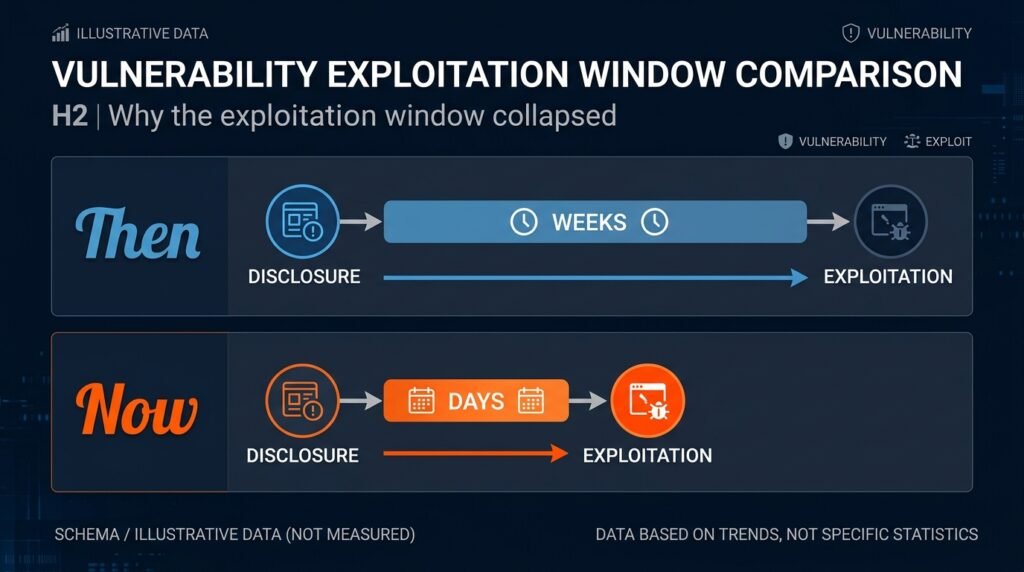
The practical consequence is that the safe assumption has inverted. It used to be reasonable to assume you had a few weeks after a patch before exploitation was likely. Now the safe assumption for internet-facing infrastructure is days.
The 6 changes that actually help
1. Build an asset inventory before anything else
You cannot patch what you do not know you run. This sounds obvious and is skipped almost universally, because it is tedious and produces no visible security improvement on the day it is finished.
It is still the highest-value thing on this list. Every hour spent during an emergency working out whether you run the affected product is an hour attackers get for free. A spreadsheet listing systems, versions, internet exposure and an owner is enough to start.
2. Split your patching into two tracks
Stop treating all patches as one queue. Run an emergency track and a routine track.
The emergency track handles anything that is internet-facing, actively exploited, or both — measured in hours to days. The routine track handles everything else on your normal cycle. Most organisations fail not because their monthly process is bad but because they have only one process.
3. Use the CISA KEV catalog as your priority filter
Severity scores tell you how bad a flaw could be. They do not tell you whether anyone is using it. The CISA Known Exploited Vulnerabilities catalog lists flaws confirmed to be exploited in the wild, and it is free.
A practical rule that fits on a sticky note: anything in the KEV catalog that you actually run goes on the emergency track, regardless of its CVSS score. A CVSS 7.5 flaw under active attack is a more urgent problem than a CVSS 9.8 flaw nobody has worked out how to use.
4. Shrink what is exposed to the internet
The August incidents cluster around one characteristic: management interfaces and remote-access services reachable from the open internet. The scale of that problem is already well documented — researchers have found hundreds of thousands of publicly exposed APIs sitting in production.
Every service you remove from public exposure is a patch you no longer need to apply within 48 hours. VPN and management interfaces behind access controls, administrative panels restricted by IP, and unnecessary services turned off do more for your risk position than any tooling purchase.
5. Pre-authorise emergency patching
Plenty of organisations lose days to approval rather than to technical work. If your change process requires a committee to approve an emergency patch on an actively exploited internet-facing system, the process is the vulnerability.
Agree in advance, in writing, which categories of patch can be applied immediately and who can make that call at 9pm on a Friday.
6. Verify, do not assume
Patches fail. Services do not restart, reboots get deferred, one server in a cluster gets missed, an update rolls back.
Confirm the version after patching rather than trusting the management console’s report. The NIST guidance on enterprise patch management is the most useful free reference here, and it is written for organisations that do not have a dedicated team.
What this means if you are a small business
Almost everything above assumes an IT function. Many businesses do not have one. The version that works at that scale is shorter.
- Turn on automatic updates everywhere you reasonably can. The risk of an update breaking something is now consistently smaller than the risk of running unpatched software.
- Write down what you run — devices, key software, anything reachable from outside. One page is fine.
- Know who your emergency contact is before you need them, whether that is an IT provider or a specific staff member.
- Ask your managed service provider one question: how quickly do they apply patches for actively exploited vulnerabilities, and how would they tell you? A vague answer is itself an answer.
- Prioritise anything internet-facing — your website, remote access, cameras, network hardware.
Small organisations are not too small to be targeted. Mass exploitation of internet-facing flaws is indiscriminate by design; attackers scan for the vulnerable version, not for a company worth attacking.
What to watch next
Two developments are worth tracking through the rest of 2026.
Ransomware infrastructure is getting harder to disrupt. The DeadLock group has been observed using decentralised infrastructure for victim communications and leak operations, specifically to improve resilience against takedowns. Takedown-based disruption becomes less effective as this spreads.
Cloud-managed patching changes the model. When Microsoft disclosed a maximum-severity remote code execution flaw in Entra ID in August 2026, there was no customer-facing update to deploy, because the service is cloud-managed and had already been patched server-side. That is a genuine improvement in response speed. It also means your exposure increasingly depends on vendor decisions you cannot see or control — which is a different risk, not an absent one.
The bottom line
Patch management did not become more important in 2026. It became more time-sensitive, which is not the same thing and requires a different response.
The organisations that handle this well are rarely the ones with the most tooling. They are the ones that know what they run, have a way to move fast when it matters, and have reduced how much is exposed in the first place.
If you do one thing after reading this: check whether anything you operate appears in the CISA KEV catalog. That single comparison, done honestly, tells you more about your actual risk than a month of vulnerability scanning.
FAQs
What is patch management? Patch management is the process of identifying, testing, prioritising and applying software updates that fix security flaws across an organisation’s systems. It covers knowing what you run, knowing what is vulnerable, deciding what to fix first, and verifying the fix applied.
How quickly are vulnerabilities exploited after disclosure? For internet-facing enterprise software, days is now a realistic assumption. In August 2026 a maximum-severity SAP Commerce Cloud flaw drew exploitation attempts within days of disclosure, and a newly patched VMware vCenter flaw was used to deploy ransomware shortly after its fix was released.
Is monthly patching still enough? Not as a single process. A monthly cycle remains fine for routine updates, but internet-facing and actively exploited vulnerabilities need a separate emergency track measured in hours to days.
What is the CISA KEV catalog? The Known Exploited Vulnerabilities catalog is a free list maintained by the US Cybersecurity and Infrastructure Security Agency of vulnerabilities confirmed to be exploited in the wild. It is a more useful prioritisation signal than severity score alone.
Should I prioritise by CVSS score? Not on its own. CVSS describes potential impact, not whether anyone is exploiting the flaw. A moderately scored vulnerability under active attack is more urgent than a critically scored one with no known exploitation.
What was the August 2026 Patch Tuesday? Microsoft released patches for 421 CVEs, including CVE-2026-68820, a use-after-free flaw in the Windows Sockets driver already exploited in the wild to escalate privileges to SYSTEM.
How should a small business without an IT team handle patching? Enable automatic updates wherever practical, keep a one-page list of what you run, prioritise anything reachable from the internet, and confirm in advance how quickly your IT provider responds to actively exploited vulnerabilities.
Does cloud software still need patching? Some cloud services are patched by the vendor with no customer action required. That speeds up response but shifts the dependency to the provider, so it changes the nature of the risk rather than removing it.