
A disclosure before the data, because it is relevant to how you read this.
TechyKnow is a publisher. We depend on search traffic. Almost every article you will find on this topic is published by a company selling SEO services, AI visibility tools or traffic recovery consulting, and almost none of them says so. We are not selling you anything here, but we are not neutral either, and you should know that.
With that said, here is the finding that most coverage misses.
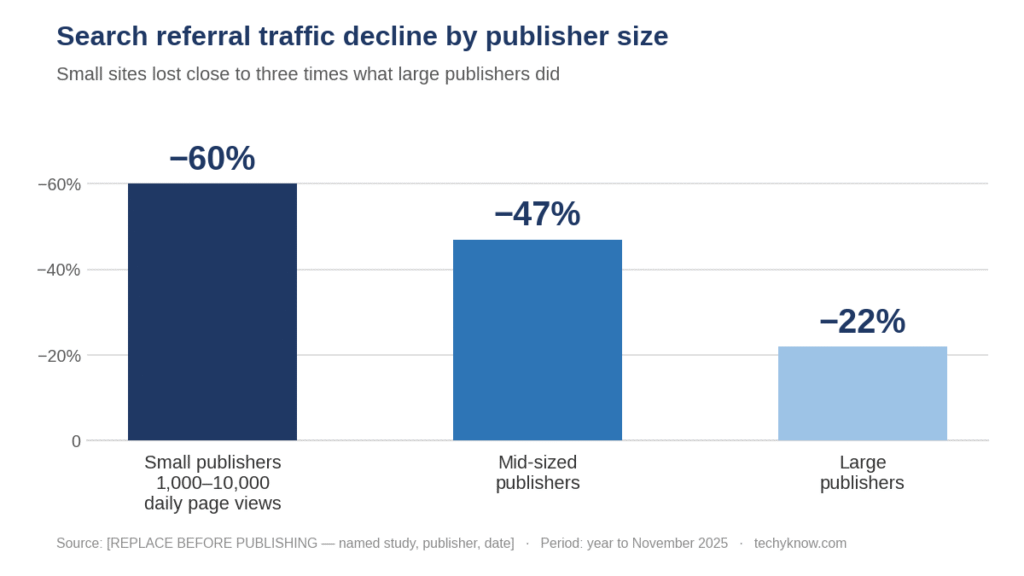
The traffic loss from AI Overviews was not evenly distributed. Reported figures indicate small publishers lost around 60% of search referral traffic, mid-sized publishers around 47%, and large publishers around 22%. A small site did not experience a slightly worse version of what a large site experienced. It experienced something close to three times worse.
That changes what the story is. This is not simply a decline. It is a redistribution — and redistribution has winners, which the word “decline” obscures.
Table of contents
- What the numbers actually say
- Why the damage is uneven
- Zero-click is the underlying shift
- Does ChatGPT make up the difference?
- A note on the statistics in this space
- What actually works
- What does not work
- Where we think this goes
- FAQs
What the numbers actually say
Four sets of figures, each attributed, because a lot of what circulates on this topic is not.
Overall referral decline. Digiday reported a 25% drop in publisher referral traffic linked to AI Overviews. Other analyses put the fall higher — approximately 33% globally in the year to November 2025, with US publishers around 38%.
On queries where AI Overviews appear. The effect is sharper. Reported analysis puts the organic click-through-rate drop on AI Overview queries at around 61%, with clicks to the number-one result down 34.5% in April 2025 and reaching 58% by December 2025.
By publisher size. Small publishers, defined as roughly 1,000–10,000 daily page views, down around 60%. Mid-sized down around 47%. Large publishers down around 22%.
Beyond search. Google Discover referrals to more than 2,500 publisher sites fell approximately 21% — worth noting because Discover was, for several years, the diversification answer.
Two caveats that belong with these figures rather than in a footnote. Several trace to analyses cited in secondary coverage rather than to published methodology, and the click-decline figures entered wide circulation partly through antitrust filings, where the party presenting them had an interest in the framing. The direction is consistent across independent sources. The precision is softer than the decimal places suggest.
Why the damage is uneven
The size gradient is the most useful thing in the data, and it has a straightforward explanation.
Small publishers depend disproportionately on informational queries. A site that grew by answering “what is X” and “how do I Y” was serving exactly the query type AI Overviews answers directly. That is not incidental — informational long-tail was the standard route to building an audience without brand recognition, because it was the only competition a small site could win.
Large publishers have non-search demand. People type their name into a browser, subscribe to their newsletters, follow them on social platforms and open their apps. Search is one channel among several. When it falls 22%, the business absorbs it.
Brand queries are unaffected by AI Overviews. Nobody searches “New York Times” and gets a summary instead of the site. The entire mitigation is having a name people already search for, which is exactly what small publishers do not have.
Small publishers rank for fewer, more concentrated terms. A large site’s traffic is spread across tens of thousands of queries, so a change hitting one type is diluted. A small site with a handful of strong pages has no dilution available.
The uncomfortable summary: the sites hit hardest are the ones for which search was the only viable route in. That is a structural feature of how AI Overviews interact with query types, not a penalty anyone applied.
Zero-click is the underlying shift
The metric that explains everything above: zero-click searches reached approximately 68% in early 2026, up from around 60% in 2024.
A zero-click search is one where the person gets what they wanted and never leaves the results page. This predates AI Overviews — featured snippets, weather, calculators, sports scores and knowledge panels all did it — but it has accelerated, and the acceleration reaches a much broader class of question.
The important reframing is that Google did not break a contract. There was never a contract. The arrangement in which a search engine sent traffic to publishers in exchange for content was an emergent equilibrium, not an agreement, and equilibria shift when one party’s product changes.
That does not make it painless or fair. It does mean strategies premised on the old equilibrium returning are premised on something unlikely.
Does ChatGPT make up the difference?
The hopeful theory is that AI assistants become the new referral source. The reported data does not support that yet.
ChatGPT referrals to publishers grew by over 200%, which sounds decisive until the base is included: they still account for less than 1% of all referrals.
A large percentage increase on a very small number is a very small number. AI assistant referrals are worth tracking and worth being findable in, but a publisher planning around them replacing search traffic in the near term is planning on something not currently visible in the data.
A note on the statistics in this space
Worth stating plainly, because it affects everything you will read on this topic.
The numbers circulating are abundant, dramatic and frequently unattributed. Aggregator posts cite other aggregator posts. Figures appear with no sample, methodology or date. Several of the most repeated statistics trace back to a single analysis that has been reproduced so widely it reads as consensus.
Every figure in this article carries a source and a period. Where the underlying methodology is not public, we have said so. If you are making business decisions on this topic, apply the same filter to everything else you read — and be especially careful with figures published by companies selling the solution to the problem those figures describe.
What actually works
Structured by publisher size, because the data says that is the variable that matters.
If you are a small publisher (the ~60% band):
The honest answer is that recovering the old traffic level through search alone is unlikely, and strategies premised on it will waste the time you have.
- Move up the query difficulty curve. The queries AI Overviews answers well are simple, factual and settled. The queries it answers badly are ones requiring judgement, current information, original reporting, comparison with real trade-offs, or experience. That is the ground to compete on, and it is harder work than the informational long-tail was.
- Build a channel you own. A newsletter is the least glamorous and most reliable answer. An audience that arrives directly is unaffected by any of this.
- Accept a smaller, better audience. Traffic that arrived from a factual query and left in nine seconds was never worth much. Some of what was lost was traffic that never converted to anything.
If you are mid-sized (the ~47% band):
- Audit which pages lost. The loss is not uniform across a site. Some pages are down 80% and others are flat. That distribution tells you which content types still earn clicks.
- Invest in the query types that survived. Follow the data rather than the advice.
- Build brand queries deliberately. This is the single structural protection, and it is slow.
If you are large (the ~22% band):
- Treat this as a diversification signal rather than an emergency. You absorbed it, which means you have time others do not.
For everyone:
- Be citable. Clear claims, real data, dated statements and genuine expertise are what get referenced by AI systems. This is largely the same thing as being good, which is inconvenient but true.
- Measure impressions alongside clicks. If you are being summarised rather than clicked, impressions and brand awareness may be holding while clicks fall. That is a different problem from disappearing.
What does not work
Four responses that consume effort and return little.
Waiting for reversal. Zero-click has risen steadily for years across multiple mechanisms. This is a trend, not an event.
Publishing more of the same. If informational content is being summarised, more informational content is more material to summarise.
Blocking AI crawlers as a strategy. Defensible as a rights position, and a poor traffic strategy — you become uncitable rather than well-compensated.
Buying “AI visibility” tooling as a first move. Some of it is useful. None of it fixes a content mix aimed at queries that no longer produce clicks. The tool is a measurement layer, not a strategy.
Where we think this goes
Labelled clearly as our view rather than reporting.
The informational long-tail as a route to building a publishing audience is probably finished. It worked because search engines could not answer questions directly and needed somewhere to send people. That constraint is gone, and we do not expect it to return.
What we think survives: original reporting, genuine expertise, opinion and analysis, community, and anything where the reader wants a specific source rather than an answer. Also, and less romantically, brands — because a brand query is a query an AI summary does not intercept.
What we are unsure about: whether AI assistant referrals eventually become meaningful, and whether the emerging economics of paid content licensing reach anyone below the largest publishers. Both are open, and anyone confident either way is guessing.
The broader shape rhymes with what TechyKnow has covered through agentic AI: AI systems taking over the tasks that had a clear right answer, and leaving the ones requiring judgement. Search was the same. Answering a factual question was a task with a right answer. Being worth reading is not.
The practical next step: open Search Console, sort your pages by click loss over the last twelve months, and look at what the worst-hit pages have in common. In our experience it is a query type rather than a topic — and knowing which one it is for your site is worth more than any general advice in this article.
FAQs
How much traffic have publishers lost to AI Overviews?
Reported figures indicate Google search traffic to publishers fell around 33% globally in the year to November 2025, with US publishers down around 38%. The loss is uneven by size: small publishers around 60%, mid-sized around 47%, and large publishers around 22%.
What are zero-click searches?
A zero-click search is one where the person finds what they need on the results page and never visits a website. Zero-click searches reached approximately 68% in early 2026, up from around 60% in 2024. AI Overviews accelerated a trend that featured snippets and knowledge panels began.
Do AI Overviews actually reduce clicks?
Yes, substantially, on queries where they appear. Reported analysis puts the organic click-through-rate drop at around 61% on those queries, with clicks to the number-one result falling 34.5% in April 2025 and reaching 58% by December 2025.
Why did small publishers lose more than large ones?
Three reasons. Small publishers depend disproportionately on informational queries, which is exactly what AI Overviews answer directly. Large publishers have non-search demand — brand searches, newsletters, apps. And brand queries are unaffected by AI summaries, which protects sites people already know by name.
Does ChatGPT send meaningful traffic to publishers?
Not yet. ChatGPT referrals to publishers grew over 200%, but still account for less than 1% of all referrals. Worth tracking; not currently a replacement for search traffic.
How do I optimise for AI Overviews?
Being cited depends largely on being clear, specific, current and demonstrably expert — direct answers to real questions, dated claims, and information a summary cannot substitute for. The more durable strategy is moving toward query types that require judgement, comparison or original reporting, which summaries answer poorly.
Should I block AI crawlers?
That is a rights and licensing decision rather than a traffic strategy. Blocking makes you uncitable rather than better compensated. Publishers with genuine licensing leverage may reasonably decide otherwise; most do not have it.
Is SEO dead in 2026?
No, but one specific version of it is much weaker: ranking for simple informational queries to build an audience from nothing. Search still sends substantial traffic, particularly to sites with brand recognition and content requiring judgement rather than facts.