
China Cybersecurity has opened a formal cybersecurity review of Palo Alto Networks products, a move announced on August 6, 2026 by the country’s Cyberspace Administration. The review targets products the U.S. cybersecurity giant sells inside China, and regulators say it’s meant to protect the country’s critical information infrastructure from national security risks. No specific products, vulnerabilities, or timelines have been disclosed yet but the action lands squarely inside a much bigger, much older fight between Washington and Beijing over who controls the technology running inside each other’s networks.
If you’re trying to understand what this review actually means, whether it’s connected to earlier bans, and what could happen next, here’s everything confirmed so far.
Key Takeaways
- China’s Cyberspace Administration (CAC) launched a formal cybersecurity review into Palo Alto Networks products on August 6, 2026.
- The review is being carried out by the Cybersecurity Review Office under China’s National Security Law, Cybersecurity Law, and Cybersecurity Review Measures.
- Regulators have not named the specific products under review or disclosed any alleged vulnerabilities.
- This follows a January 2026 directive telling Chinese firms to stop using cybersecurity software from Palo Alto Networks and more than a dozen other U.S. and Israeli companies.
- The process mirrors China’s 2023 review of Micron Technology, which ended in a purchase ban for operators of critical infrastructure.
- Palo Alto Networks says the review currently has no impact on its ability to serve customers or deliver products in China.
What Is the China Cybersecurity Review Into Palo Alto Networks?
The China cybersecurity review of Palo Alto Networks is a formal legal process opened by the Cyberspace Administration of China (CAC), specifically through its Cybersecurity Review Office. According to the regulator’s statement, the goal is to <cite index=”4-1″>protect the safe and stable operation of critical information infrastructure, prevent cybersecurity vulnerabilities and risks, and safeguard national security.</cite>
The review is grounded in three legal instruments: <cite index=”4-1″>the National Security Law, the Cybersecurity Law, and the Cybersecurity Review Measures of China.</cite>
What’s notably absent from the announcement is detail. Regulators have <cite index=”2-1″>not identified the products involved, detailed alleged vulnerabilities, or said what action Palo Alto could face.</cite> That vagueness isn’t necessarily new it’s consistent with how China has handled comparable reviews of foreign tech companies in the past.
Why Palo Alto Networks Specifically?
Palo Alto Networks is one of the largest cybersecurity vendors in the world, with products spanning networking, cloud security, and security operations. <cite index=”4-1″>Its recent product lineup includes Cortex AgentiX, a platform built to counter threats from AI agents, and its customer base spans the public sector, financial services, manufacturing, healthcare, and transportation.</cite> that focus on AI-driven threats isn’t happening in a vacuum — it follows a broader industry shift toward defending against autonomous AI-powered attacks and the kind of AI-driven hacking capabilities OpenAI itself has flagged as an emerging risk.
That scale is part of the concern regulators cited. Chinese analysts quoted by state media argued that <cite index=”4-1″>the company’s wide product coverage across networking, cloud, security operations, and AI raises the likelihood of systemic security risks, and that the review also puts current customers on notice to check for technical vulnerabilities or security shortcomings.</cite>
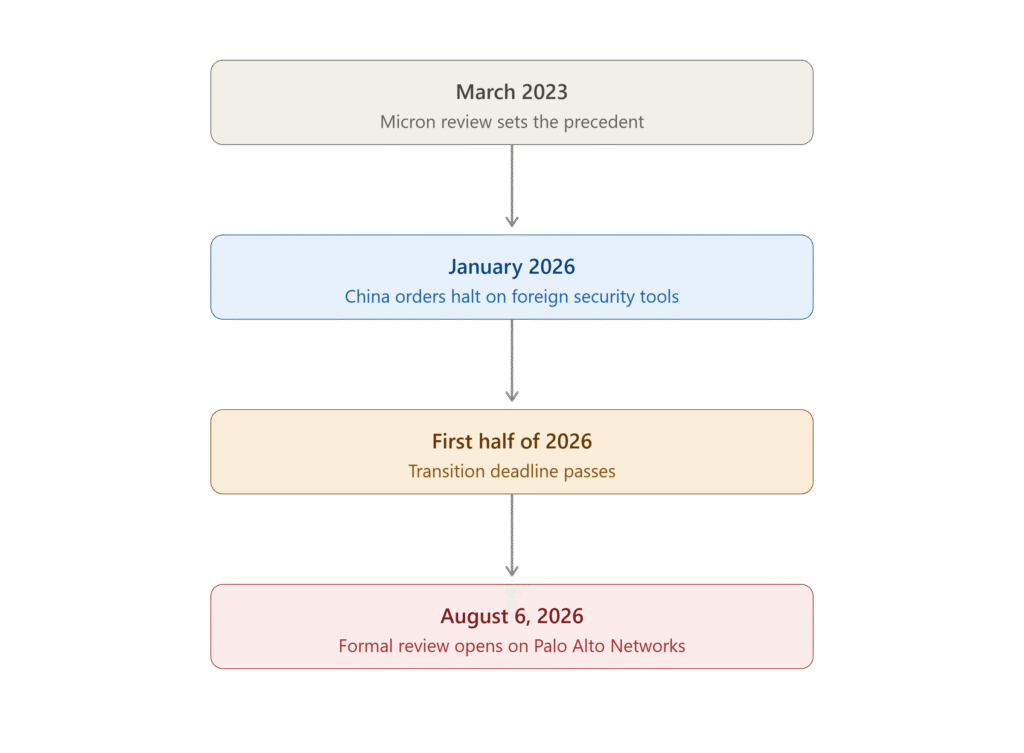
Timeline: How the Palo Alto Networks Situation in China Escalated
This didn’t happen overnight. The review is the latest step in a pattern that’s been building for months.
| Date | Development |
|---|---|
| March 2023 | China’s CAC launches its first proactive security review of a foreign company — Micron Technology. |
| January 2026 | Chinese authorities instruct domestic firms to stop using cybersecurity software from Palo Alto Networks and over a dozen other U.S. and Israeli firms, including Fortinet, Check Point, CrowdStrike, and VMware. |
| H1 2026 | Deadline passes for Chinese organizations to transition away from the named foreign cybersecurity vendors. |
| August 6, 2026 | CAC formally opens a national security review into Palo Alto Networks products under the Cybersecurity Review Measures. |
The January 2026 directive is the piece that matters most for context. It was <cite index=”5-1″>a Bloomberg-reported order, seen by Bloomberg News, that cited concerns Western software could collect and transmit sensitive information abroad,</cite> and it named a long list of companies beyond Palo Alto — <cite index=”5-1″>Fortinet, Check Point, CrowdStrike, VMware (now under Broadcom), SentinelOne, Mandiant (now under Alphabet), Recorded Future (now under Mastercard), and Wiz, among others.</cite>
That earlier move was procurement guidance, not law. This new review changes that. As one analysis put it, Beijing has <cite index=”5-1″>upgraded its approach from informal procurement guidance, which carried no formal legal weight, to the Cybersecurity Review Office mechanism, which does.</cite>
How Does This Compare to the Micron Technology Review?
If you want a preview of how this could play out, the closest precedent is Micron.
- Micron’s review, launched in March 2023, was <cite index=”5-1″>the first time the CAC proactively launched a review against a foreign company.</cite>
- The <cite index=”2-1″>CAC later said Micron’s products had failed the review and told operators of China’s critical information infrastructure to stop buying them, citing national security risks.</cite>
- The fallout was real and lasting: <cite index=”2-1″>Micron has since stopped supplying server chips to data centers in China after the business failed to recover from the ban, though it continues to sell to some Chinese customers in the automotive and mobile-phone sectors.</cite>
That outcome is why the Palo Alto review is being watched closely. It’s the same regulatory pathway, run by the same office, under the same laws — and it produced a years-long, largely irreversible market exit for Micron in one segment of its business.
Micron vs. Palo Alto Networks Review: Quick Comparison
| Factor | Micron Technology (2023) | Palo Alto Networks (2026) |
|---|---|---|
| Reviewing body | Cyberspace Administration of China | Cybersecurity Review Office (under CAC) |
| Legal basis | China’s cybersecurity and national security laws | National Security Law, Cybersecurity Law, Cybersecurity Review Measures |
| Product transparency | Not detailed publicly | Not detailed publicly |
| Outcome so far | Products failed review; purchase ban for critical infrastructure operators | Review ongoing; no outcome yet |
| Business impact | Stopped supplying server chips to Chinese data centers | Company says no current impact to operations |
What Has Palo Alto Networks Said About the Review?
Palo Alto Networks has responded, but carefully. A company spokesperson told The Register: <cite index=”6-1″>”We maintain the highest standards of business conduct and security practices and ethics across our global operations. At this time, there is no impact to our ability to support customers or deliver our products and services in the region.”</cite>
Beyond that statement, the company hasn’t disclosed how much revenue it generates from China or what its contingency planning looks like. Analysts note that <cite index=”3-1″>China’s share of Palo Alto Networks’ total revenue isn’t publicly broken out with enough granularity to calculate exact exposure, though the company does maintain physical offices in the country and has been actively selling products there.</cite>
Markets reacted immediately to the news. <cite index=”1-1″>Shares in Palo Alto Networks fell as much as 4.2% before later paring losses in pre-market trading.</cite>
Why Is China Doing This Now? The Bigger Trade Context
This review didn’t happen in isolation. It’s unfolding against a backdrop of <cite index=”2-1″>growing trade and technology tensions between Beijing and Washington that have threatened an uneasy truce reached at recent high-level bilateral summits.</cite>
There’s also a near-simultaneous trigger on the trade side: the review <cite index=”4-1″>came just a day after China’s Ministry of Commerce announced a string of countermeasures in response to continued U.S. actions.</cite>
And the pressure isn’t one-directional. On the American side, <cite index=”7-1″>Washington has reportedly been drafting its own restrictions on Chinese devices in U.S. data centers, meaning both governments are now moving against each other’s hardware and software at roughly the same time.</cite>
Beijing’s broader strategy has been consistent: <cite index=”2-1″>stepping up scrutiny of foreign technology suppliers while promoting domestic alternatives, on the reasoning that imported products used in sensitive networks could expose data or infrastructure to overseas risk.</cite>
What Could Happen Next?
Nobody — including Palo Alto Networks — knows the outcome yet. But there are a few things worth understanding about how these reviews typically function and what options are on the table.
How the review process tends to work:
- The Cybersecurity Review Office opens a formal review under the relevant laws.
- No public timeline is set, and reviews can stretch on for extended periods with minimal public updates.
- During the review, the company’s ability to sell into critical sectors can be constrained, even before any formal finding.
- The review concludes with either clearance or a finding of risk, which can lead to a purchase ban for critical infrastructure operators (as with Micron).
One analysis described the mechanism this way: in China, this kind of review <cite index=”7-1″>can restrict a company’s ability to sell into critical sectors while it’s underway, giving the process real bite regardless of its eventual findings.</cite> Reviews of this kind are <cite index=”7-1″>rarely quick, and they can stretch on with little public explanation, leaving a company in limbo and its customers uncertain whether to keep buying — which is itself part of the pressure the process exerts.</cite>
Steps Palo Alto Networks could take to navigate the review:
- Proactively offer <cite index=”8-1″>China-recognized third-party institutions the chance to test source code, firmware, the upgrade mechanism, data transmission interfaces, remote maintenance functions, and the supply chain, then produce reports covering vulnerabilities and outbound data-transfer risk.</cite>
- Offer a controlled environment or code-hosting mechanism for source-code review, while <cite index=”8-1″>avoiding handing over the complete source code outright, given the intellectual property concerns, the risk of triggering U.S. export controls, and the potential global security implications.</cite>
Pros and Cons: What This Review Means for Different Stakeholders
For Chinese regulators:
- Pro: Reinforces domestic control over critical infrastructure security.
- Pro: Sends a clear signal to other foreign vendors about compliance expectations.
- Con: Risks further strain on an already fragile US-China trade relationship.
For Palo Alto Networks:
- Pro: Company maintains it currently faces no operational disruption.
- Con: Faces potential loss of access to China’s critical infrastructure market, similar to Micron’s experience.
- Con: Prolonged uncertainty could affect customer confidence in the region.
For the global cybersecurity market:
- Con: Accelerates a broader fragmentation, where vendors increasingly serve either a US-aligned or China-aligned bloc rather than both.
- Con: Complicates long-term planning for any security vendor treating China as a growth market.
Frequently Asked Questions
What is the China cybersecurity review of Palo Alto Networks?
It’s a formal national security review opened by China’s Cyberspace Administration on August 6, 2026, examining Palo Alto Networks products sold in China. It’s being conducted under China’s National Security Law, Cybersecurity Law, and Cybersecurity Review Measures.
Which Palo Alto Networks products are under review?
China’s regulators have not identified specific products, disclosed alleged vulnerabilities, or specified what action the company could face.
Is this related to the January 2026 ban on foreign cybersecurity software?
Yes. In January 2026, Chinese authorities directed domestic organizations to stop using cybersecurity software from Palo Alto Networks and more than a dozen other US and Israeli firms. That was informal procurement guidance; this new review carries formal legal weight through the Cybersecurity Review Office.
Has Palo Alto Networks responded to the review?
Yes. A company spokesperson said Palo Alto Networks maintains high standards of business conduct and security practices, and stated there is currently no impact to its ability to support customers or deliver products in China.
What happened in the similar Micron Technology review?
China’s CAC reviewed Micron Technology starting in March 2023 and later found its products failed the review, leading to a purchase ban for operators of critical information infrastructure. Micron has since stopped supplying server chips to Chinese data centers.
How did Palo Alto Networks’ stock react to the news?
Shares fell as much as 4.2% in early trading before paring some of those losses.
Could this review lead to a full ban on Palo Alto Networks products in China?
That outcome is possible based on the precedent set by the Micron review, but no timeline or verdict has been announced, and outcomes of these reviews aren’t predictable in advance.
Why is China increasing scrutiny of foreign cybersecurity vendors now?
The move fits a broader pattern of Beijing promoting domestic technology alternatives while citing national security risk from imported products in sensitive networks. It also follows a fresh round of Chinese trade countermeasures against continued US actions.