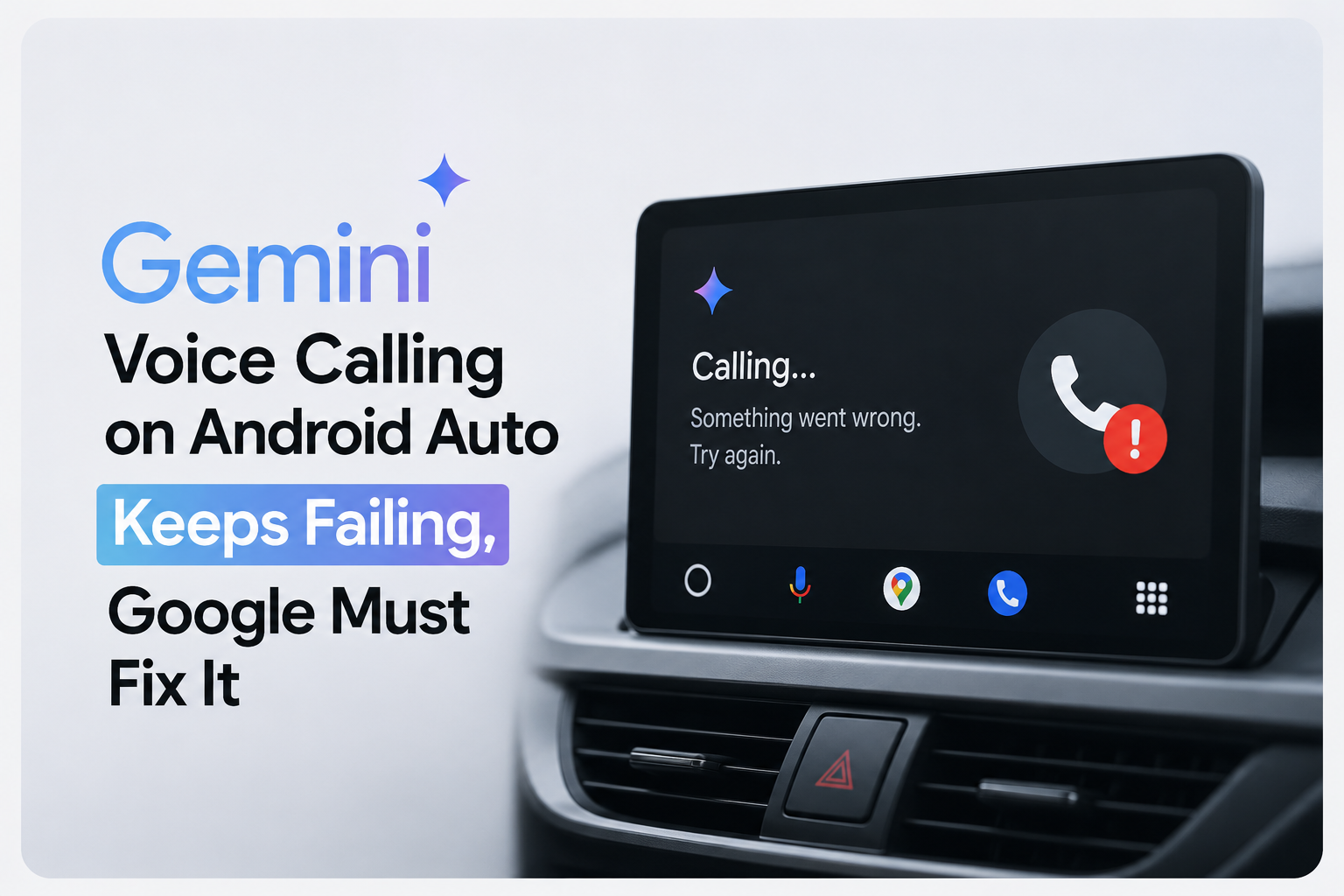
If you have tried to make a hands-free call through Gemini on Android Auto lately and gotten nothing but a vague “Something went wrong. Please try again” error, you are not imagining it. Gemini’s voice calling feature has been breaking intermittently on both Android phones and Android Auto for weeks, and the timing could not be worse: Google Assistant, the fallback most drivers have leaned on when Gemini stumbles, is being phased out starting September 4, 2026. That gives Google a hard deadline to make Gemini’s calling function actually reliable behind the wheel.
Key Takeaways
- Gemini has repeatedly failed to complete voice-activated calls on Android phones and Android Auto, throwing a generic “Something went wrong” error.
- The most common workaround has been switching the default assistant back to Google Assistant, but that is only a temporary fix.
- Google confirmed the issue and pushed an app update to resolve it, though reports of related glitches, including Gemini randomly reverting to the old Assistant icon, have continued to surface in the weeks since.
- Google Assistant is being formally discontinued on phones, tablets, Wear OS, paired earbuds, and Android Auto starting September 4, 2026, meaning the “just switch back to Assistant” workaround will disappear for most users.
- Cars with Google built-in (Android Automotive) are exempt from the September deadline and will keep Google Assistant for now.
- Hands-free calling is considered a core safety feature in the car, which is why a bug like this carries more weight than a typical app glitch.
What Is Happening with Gemini Voice Calling on Android Auto?
Over the past couple of months, a growing number of Android Auto users have reported that asking Gemini to place a call, whether by saying “Hey Google, call [contact]” or using the steering wheel voice button, simply fails. Instead of dialing, the system throws up an error message and does nothing. The bug has not been limited to the car either; the same failure has shown up when people try to place calls through Gemini directly on their Android phones.
What makes this particularly frustrating is that standard troubleshooting has not reliably fixed it. Clearing app data, reinstalling the Google and Gemini apps, and rebooting the car’s infotainment system have all been reported as ineffective by affected users.
Why Does the “Something Went Wrong” Error Keep Happening on Gemini?
Google has not published a detailed technical explanation for the root cause, but the pattern points to a server-side issue tied to how Gemini has been rolling out as the default assistant on Android Auto. The bug does not hit every user at once, which is typically a sign that it is linked to backend changes rather than a single bad update sitting on every device. Compounding the confusion, some Android Auto units have also intermittently displayed the old Google Assistant icon even while Gemini is technically handling the response, adding another layer of inconsistency to an already unpredictable experience.
How Have Users Been Working Around the Bug on Gemini?
With no immediate permanent fix in early reports, drivers found a couple of short-term paths back to functional hands-free calling:
- Switch back to Google Assistant. Going into the digital assistant settings and selecting Google Assistant instead of Gemini has restored calling for many users, though it means giving up Gemini’s more natural conversational features in the meantime.
- Uninstall the latest app update. A smaller number of users found that rolling back the most recent Google app update also restored calling, though this is not a recommended long-term approach since it can leave other features out of date.
Neither of these is a real solution. They are stopgaps for a problem Google needs to own directly, especially in a context where hands-free calling is a safety feature, not a convenience.
Did Google Fix the Gemini Calling Bug?
Google acknowledged the issue and confirmed that a fix was made available through the Google Play Store, telling affected users to update their app to the latest version to restore calling. That resolved the immediate error for a portion of users. However, reports of related problems have continued to surface since then, including Gemini occasionally getting replaced by the old Assistant icon on Android Auto displays and other reliability complaints tied to the broader Gemini rollout in vehicles. In other words, the specific calling error was patched, but confidence in Gemini’s overall consistency inside the car has not fully recovered.
Why Does Google Need to Fix This by September?
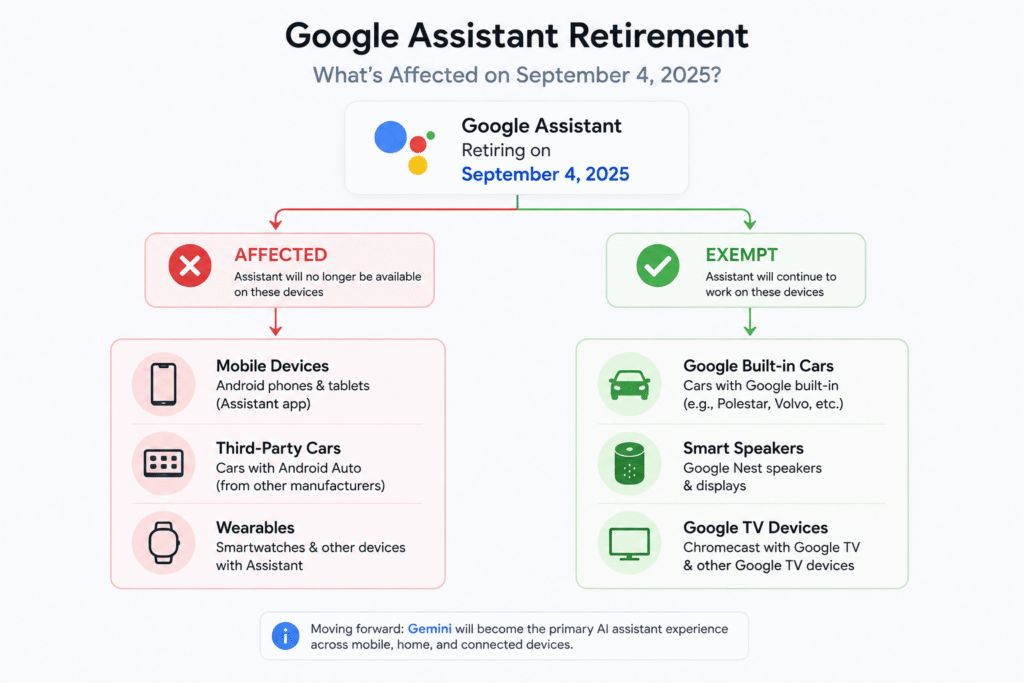
This is where the timeline becomes genuinely urgent. Google has confirmed it will begin retiring Google Assistant starting September 4, 2026, rolling out gradually across phones, tablets, Wear OS smartwatches, paired earbuds and headphones, and vehicles running Android Auto projected from a phone. Once that transition reaches a given device, there is no switching back. Gemini becomes the only first-party assistant option.
That means the workaround that has bailed out frustrated drivers, reverting to Google Assistant, will no longer exist once a device makes the switch. If Gemini’s calling reliability issues have not been fully resolved by the time Assistant disappears from a user’s car, there will be no fallback left. For a feature tied directly to driver safety, that is not a small detail.
It is worth noting one exception: vehicles with Google built-in, meaning cars running Android Automotive OS with Google Assistant integrated directly rather than projected from a phone, are not part of this September deadline and will keep Google Assistant for the time being.
Timeline: Gemini Calling Bug and the Assistant Shutdown
| Event | What Happened |
|---|---|
| Gemini calling bug reported | Users on Android and Android Auto begin seeing “Something went wrong” errors when trying to place voice-activated calls |
| Workarounds emerge | Switching to Google Assistant or uninstalling the latest update restores calling for some users |
| Google confirms and patches | Google acknowledges the issue and rolls out an app update fix through the Play Store |
| Related glitches continue | Reports persist of Gemini intermittently reverting to the old Assistant icon and other Android Auto inconsistencies |
| Assistant retirement begins | Google Assistant starts being phased out on phones, tablets, Wear OS, earbuds, and Android Auto starting September 4, 2026 |
What Happens When Google Assistant Is Retired?
Once the transition reaches a device, Google Assistant will no longer function and cannot be switched back to. Gemini becomes the default trigger for commands like “Hey Google” and the power-button long press. This affects:
- Android phones and tablets that meet Gemini’s minimum system requirements
- Wear OS smartwatches
- Compatible headphones and earbuds
- Vehicles using Android Auto projected from a connected phone
Cars with Google built-in, along with smart speakers, smart displays, and Google TV devices, are not part of this particular phase of the retirement and will continue supporting Google Assistant for now.
Gemini vs. Google Assistant: Reliability in the Car
Where Gemini has the edge:
- More natural, conversational voice interaction
- Better understanding of complex, multi-step requests
- Deeper integration with apps like Maps, Gmail, and Calendar
Where Google Assistant has historically been steadier:
- More predictable, consistent command execution
- Fewer reports of calling and automation failures in the car
- A simpler, more limited scope that leaves less room for things to break
This is really the crux of the current tension. Gemini is more capable on paper, but for a task as basic as placing a phone call while driving, predictability matters more than conversational polish. Google now has a firm deadline to close that reliability gap before it removes the safety net entirely.
Frequently Asked Questions
Why is Gemini failing to make calls on Android Auto?
Users have reported a bug where attempting to place a voice-activated call through Gemini on Android Auto returns a “Something went wrong. Please try again” error instead of dialing. The issue appears tied to a server-side or app-level problem connected to Gemini’s rollout as the default assistant.
Has Google fixed the Gemini calling bug?
Google confirmed the issue and released a fix through a Google Play Store app update. Updating to the latest version resolved the error for many users, though related Gemini reliability issues on Android Auto have continued to be reported afterward.
Can I still use Google Assistant instead of Gemini right now?
Yes, for now. You can switch your default digital assistant back to Google Assistant in your phone’s settings. This has worked as a temporary fix for the calling bug for many users.
When is Google Assistant being discontinued?
Google will begin retiring Google Assistant on phones, tablets, Wear OS smartwatches, paired earbuds, and Android Auto starting September 4, 2026. The rollout happens gradually and, once a device is switched over, there is no reverting to Google Assistant.
Will Google Assistant still work in any cars after September 4?
Yes. Vehicles with Google built-in, meaning cars running Android Automotive OS with Assistant integrated directly rather than projected from a phone, are not included in this phase of the retirement.
Is the Gemini calling issue a safety concern?
Hands-free calling is considered a core safety feature in Android Auto, designed to keep drivers from handling their phones manually while driving. A bug that breaks this functionality is a more serious issue than a typical app glitch, which is part of why the fix timeline matters so much.
What should I do if Gemini calling still fails on my Android Auto after updating?
Make sure both the Google app and Android Auto are fully updated through the Google Play Store. If the issue persists, switching your default assistant back to Google Assistant remains a working, if temporary, option ahead of the September retirement.
Where This Fits into the Bigger Google Story
Gemini’s calling reliability issues are part of a broader pattern of Google moving fast on AI integration across its platforms while working out real-world kinks along the way. It echoes a similar tension seen in Google’s other major platform decisions recently, including when Google ended its 30 percent App Store fee, a policy shift that reshaped how developers and users interact with the Play Store ecosystem. Whether it is pricing policy or assistant infrastructure, Google has been willing to make sweeping changes on tight timelines, and users are often the ones testing the rough edges in real time.
It is also a useful contrast to how Apple has approached its own software transitions. Apple’s recent iPadOS 27 beta 5 update took a much more incremental approach, refining icons, hover behavior, and Siri customization without removing an entire legacy system overnight. Google’s Assistant-to-Gemini switch is a far bigger structural change, and the calling bug is a reminder of what can go wrong when a company retires a mature, predictable system in favor of a newer one that is still finding its footing.
For more ongoing coverage of how AI assistants, mobile platforms, and app ecosystems are evolving, visit TechyKnow’s software and apps section, where we track these transitions as they happen. You can also learn more about how TechyKnow covers the stories that matter in tech on our About page.