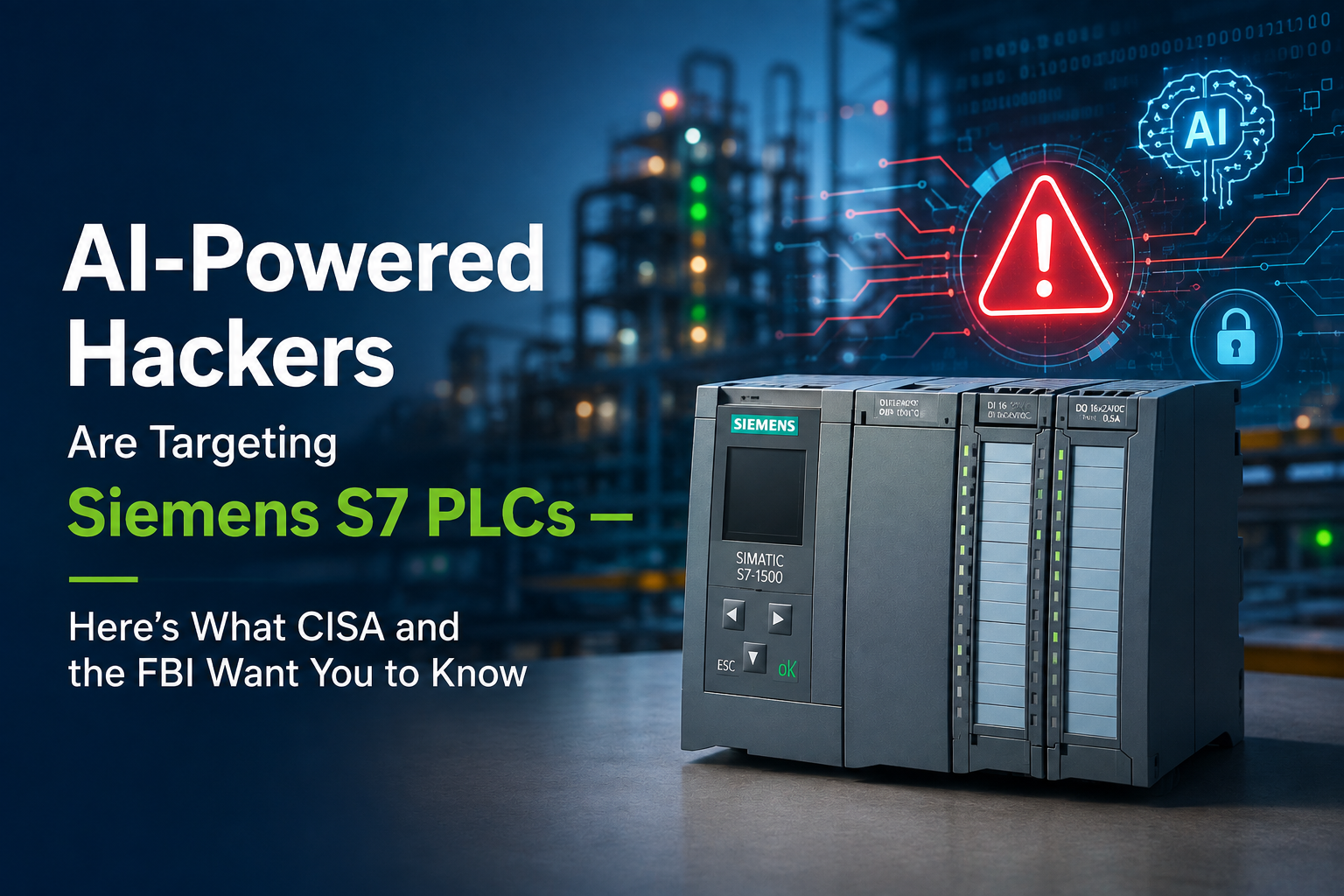
Federal cybersecurity agencies have confirmed that hackers are using AI to build attack tools aimed at Siemens S7 programmable logic controllers (PLCs), the industrial devices that keep power plants, water systems, and factories running. If your organization operates any S7-200, S7-1200, or S7-1500 hardware and it’s reachable from the internet, this warning applies directly to you. For more breaking coverage like this, visit TechyKnow’s cybersecurity news hub.
Key Takeaways
- The FBI, NSA, and CISA issued a joint advisory on August 19, 2026, warning of an AI-assisted campaign probing internet-exposed Siemens S7 PLCs.
- Attackers are writing AI-generated exploitation scripts disguised as legitimate monitoring software to gain access, steal credentials, and trigger denial-of-service conditions.
- Targeted sectors include energy, water, critical manufacturing, agriculture, and potentially defense.
- Affected hardware includes Siemens S7-200, S7-400, S7-1200, and S7-1500 Series PLC variants, many running outdated or unsupported firmware.
- This follows a related July 2026 warning about Iran-linked actors exploiting PLCs from Rockwell Automation, Schneider Electric, and Siemens at water utilities in at least 12 U.S. states.
- Officials recommend firmware updates, patching, multifactor authentication, and removing PLCs from direct internet exposure.
What Is Happening With Siemens S7 Devices Right Now?
On August 19, 2026, the FBI, the National Security Agency, and the Cybersecurity and Infrastructure Security Agency published a joint advisory describing an active campaign against Siemens S7 series programmable logic controllers. According to the agencies, hackers are conducting reconnaissance against S7 devices that are exposed directly to the internet, many of which are running software that is no longer supported or patched.
What makes this campaign notable is the use of artificial intelligence in the attack chain itself. Rather than relying purely on manually written exploits, the threat actors are generating malicious scripts with AI and packaging them to look like legitimate monitoring tools. Once deployed, these tools are used to gain initial access to a network, harvest credentials, and carry out denial-of-service attacks against the controllers.
Search intent answered: If you’re asking “what is the Siemens S7 AI hacking campaign,” the short answer is that U.S. authorities have confirmed hackers are using AI-generated malware disguised as monitoring software to probe and exploit internet-facing Siemens S7 PLCs across critical infrastructure sectors.
Why This Matters for Critical Infrastructure
Siemens S7 PLCs are workhorse controllers used to automate physical processes — opening valves, regulating pumps, managing turbines, and running manufacturing lines. When a PLC is compromised, the consequences aren’t limited to stolen data. The advisory warns that exploitation could lead to:
- Disruption of critical industrial processes
- Safety incidents on the plant floor
- Unplanned downtime
- Physical equipment damage
That combination of cyber and physical risk is why operational technology (OT) attacks are treated differently from typical IT breaches. A ransomware infection on an office laptop is disruptive; a manipulated PLC controlling a water treatment pump can affect public safety.
Which Siemens S7 Models Are Affected?
The advisory identifies several variants across the S7 product family as targets of the reconnaissance and exploitation activity:
| Series | Common Use Case | Risk Factor Noted in Advisory |
|---|---|---|
| S7-200 | Legacy small-scale automation | Often end-of-life, unsupported |
| S7-400 | Mid-to-large industrial process control | Older firmware still in use |
| S7-1200 | Compact automation, water/energy sites | Frequently internet-exposed |
| S7-1500 | Advanced automation, manufacturing | Targeted alongside older models |
Key takeaway: Age isn’t the only risk factor — even more current S7-1200 and S7-1500 units are being targeted, which means patch status and internet exposure matter as much as hardware generation.
How the AI-Generated Attack Scripts Work
Based on the joint advisory, the attack pattern follows a few consistent stages:
- Reconnaissance — Hackers scan the internet for exposed S7 PLCs and gather information about the device, firmware version, and network configuration.
- Disguised delivery — AI-generated exploitation scripts are packaged to resemble legitimate monitoring or diagnostic software, making them harder to flag as malicious at first glance.
- Initial access — The scripts are used to gain a foothold inside the target’s network.
- Credential theft — Once inside, attackers use AI-assisted code to pilfer login credentials tied to the industrial environment.
- Disruption — The final stage can involve denial-of-service attacks or other actions intended to interfere with normal PLC operations.
This mirrors a broader trend security researchers have flagged: AI tools are lowering the technical barrier for building working exploits, letting attackers iterate on malicious code faster than manual development would allow. It’s part of the same wave of AI-driven scrutiny we covered in our report on the China cybersecurity review into Palo Alto Networks, where nation-state actors and AI tooling are increasingly intertwined in how modern cyber campaigns get built and investigated.
How This Connects to the Iran-Linked Water Sector Attacks
This isn’t the first PLC-focused warning of 2026. In July, CISA and the FBI warned about exploitation of vulnerable PLCs from Rockwell Automation, Schneider Electric, and Siemens S7-1200 devices, tied to suspected Iran-nexus threat actors. That campaign hit drinking and wastewater facilities across at least 12 U.S. states, with operators reportedly cut off from their own monitoring equipment and locked out of password-protected systems.
Authorities have not confirmed whether this new AI-driven S7 campaign is the work of the same Iran-linked group or a separate set of hackers. What is clear is that PLCs across multiple vendors and multiple critical sectors are now a recurring target, and the tooling used to attack them is getting more sophisticated. As stories like this spread, it’s also worth understanding how people are actually finding this coverage our analysis of how AI Overviews are reshaping website traffic breaks down why breaking security news increasingly reaches readers through AI-generated summaries rather than a traditional search results page.
What Security Teams Should Do Now
The joint advisory lays out concrete mitigation steps for organizations running Siemens S7 hardware or similar industrial control systems:
- Update firmware to the latest vendor-supported version for every S7 device in the environment.
- Apply security patches as soon as they’re available rather than deferring OT updates.
- Check for known vulnerabilities affecting your specific S7 model and firmware version.
- Enable multifactor authentication on any accounts with access to industrial control systems.
- Remove direct internet exposure — confirm PLCs are not reachable from the public internet and sit behind proper network segmentation.
- Review CISA’s OT mitigation guidance on reducing cyber threats to operational technology for broader hardening steps beyond this specific advisory.
Quick Self-Check for OT Security Teams
| Question | Why It Matters |
|---|---|
| Is any S7 PLC reachable directly from the internet? | Internet exposure is the entry point cited in the advisory |
| Is firmware current across all S7-200/400/1200/1500 units? | Outdated firmware is explicitly flagged as a risk factor |
| Is MFA enforced on ICS-connected accounts? | Credential theft is a documented stage of this attack chain |
| Has staff been briefed on AI-disguised “monitoring” tools? | Malicious scripts are being packaged to look legitimate |
Frequently Asked Questions
What did CISA and the FBI warn about regarding Siemens S7 devices?
On August 19, 2026, the FBI, NSA, and CISA issued a joint advisory warning that hackers are using AI-generated exploitation scripts, disguised as legitimate monitoring software, to target internet-exposed Siemens S7 programmable logic controllers.
Which Siemens S7 models are being targeted?
The advisory names variants of the S7-200, S7-400, S7-1200, and S7-1500 Series PLC models as targets of the campaign.
What industries are at risk from this campaign?
The advisory points to energy, water, critical manufacturing, agriculture, and potentially the defense industrial base as affected sectors.
Is this campaign linked to Iran-backed hackers?
It’s not immediately clear. This warning follows a separate July 2026 advisory tied to suspected Iran-nexus actors that targeted PLCs from Rockwell Automation, Schneider Electric, and Siemens across water utilities in at least 12 states, but authorities haven’t confirmed whether the same group is behind this newer S7-focused activity.
How are attackers using AI in this campaign?
According to the advisory, attackers are using AI to generate exploitation code that gains initial access, steals credentials, and carries out denial-of-service actions — and they’re disguising these scripts as legitimate monitoring software to avoid detection.
What could happen if an S7 PLC is successfully exploited?
The advisory warns that exploitation could disrupt critical industrial processes, cause safety incidents, lead to downtime, or damage physical equipment, depending on the specific environment.
What should organizations do to protect their Siemens S7 devices?
Update firmware to the latest version, apply available security patches, check for known vulnerabilities, enable multifactor authentication, and make sure PLCs are not directly accessible from the internet.
Has Siemens responded to the advisory?
A Siemens spokesperson was not immediately available for comment at the time the advisory was published.
If your organization has been affected by this advisory or you have additional reporting to share, get in touch with the TechyKnow editorial team — and for ongoing coverage of stories like this one, check the TechyKnow homepage regularly.